Sample Report - Example Only

Wartegg Drawing Completion Test

This example shows the structure and evidence limits of a complete InnerCanvas report. It is not an assessment of the viewer.

Try This Test - Free
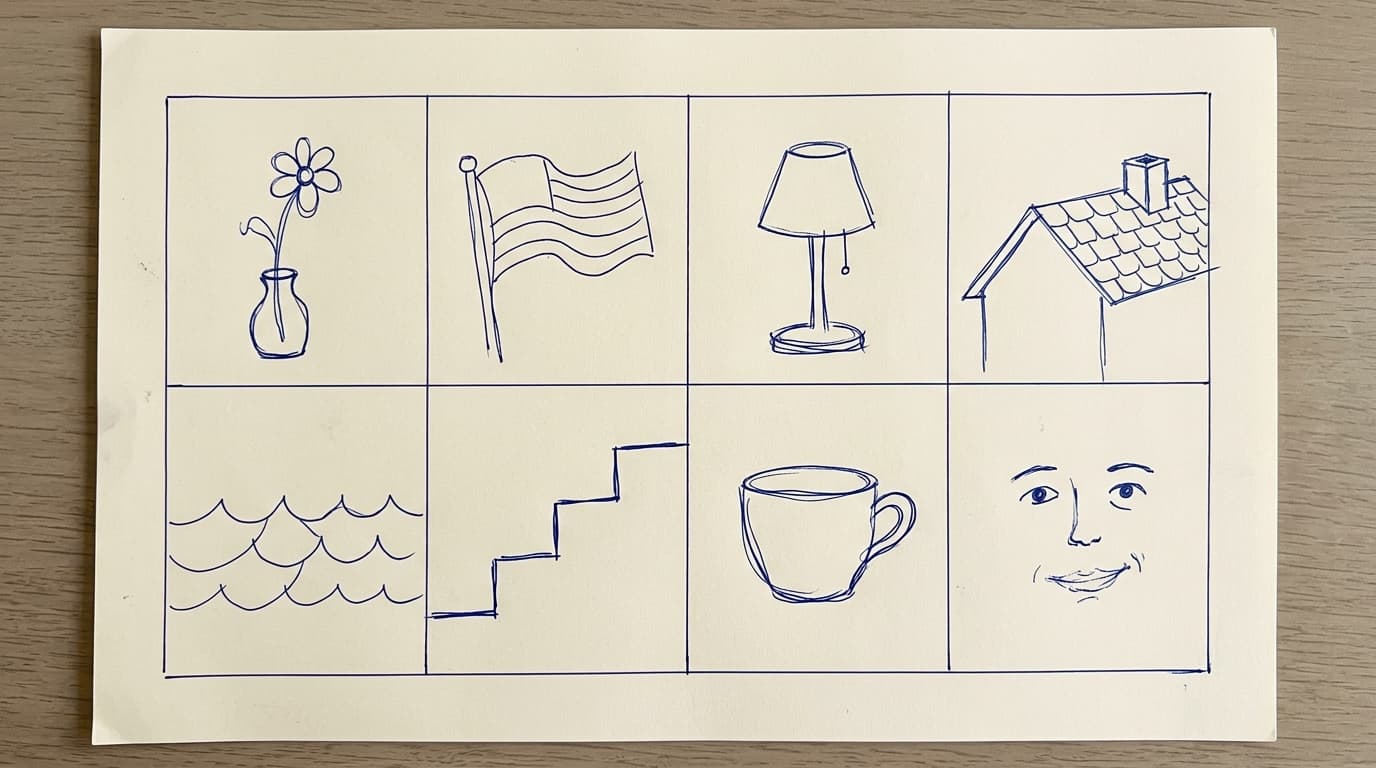
Example drawing: Wartegg Drawing Completion Test
Product-created example drawing. No real user's content is shown.

Quick Read

  • The protocol is fully completed across all eight fields using a blue pen medium, demonstrating a high level of task engagement and structured execution within the provided boundaries.
  • The drawings consistently integrate the original stimuli into concrete, recognizable objects (such as a flower, flag, lamp, house, waves, stairs, cup, and face), showing a preference for structured and practical representation.
  • The absence of written titles, sequence numbers, or preference indicators limits the application of standard sequence and verbal association analyses, highlighting the need to focus on formal features for self-reflection.
  • The clean, continuous line quality and balanced composition across all fields suggest a controlled and disciplined approach to the drawing task, though these features do not provide direct evidence of stable psychological traits.

Observation before interpretation

What We Observed

  • In Field 1 (top-left), a flower in a vase is drawn. The central dot stimulus is integrated as the center of the flower, with petals drawn around it.
  • In Field 2 (top-middle-left), a flag on a pole is drawn. The wavy line stimulus is integrated into the wavy stripes and top edge of the flag.
  • In Field 3 (top-middle-right), a table lamp is drawn. The three ascending parallel lines stimulus is integrated into the lamp's structure, possibly the base or stem, though they are not distinctly visible as three separate ascending lines.
  • In Field 4 (top-right), a house roof with a chimney is drawn. The small square stimulus in the upper right is integrated into the chimney structure.
  • In Field 5 (bottom-left), three rows of wavy lines representing water waves are drawn. The two opposing slanted lines stimulus is integrated into or overdrawn by the wavy lines.
  • In Field 6 (bottom-middle-left), a staircase is drawn. The horizontal and vertical lines stimulus is integrated into the steps of the staircase.
  • In Field 7 (bottom-middle-right), a coffee cup is drawn. The dotted semicircle stimulus is integrated into the curved bottom or handle of the cup using continuous lines.
  • In Field 8 (bottom-right), a human face (eyebrows, eyes, nose, mouth) is drawn. The curved arch stimulus is integrated as one of the eyebrows.
  • The drawings across all fields are executed with clean, continuous, and confident pen lines, with minimal sketching or overlapping strokes.
  • Each drawing is well-centered and contained within its respective field boundary, with no lines crossing over the outer borders of the fields.
  • The drawings show a moderate level of detail, such as the individual tiles on the house roof in Field 4, the stripes on the flag in Field 2, and the facial features in Field 8.

Protocol overview

The completed Wartegg drawing sheet displays a fully completed set of eight drawings, each executed within its designated square boundary. The medium used is a blue ink pen, which provides clear, high-contrast lines that are easily readable against the light-colored paper. The overall image quality is excellent, with no visible glare, blurriness, or cropping issues, allowing for a precise examination of the formal features and stimulus integration strategies employed by the drawer.

A notable aspect of this protocol is the absence of written metadata on the sheet itself, such as drawing titles, sequence numbers indicating the order of execution, or indicators of preferred and least preferred drawings. In standard clinical or research administrations, this metadata is often collected to provide additional context and to analyze the drawer's decision-making process. The lack of this information limits the application of traditional sequence-based scoring systems, requiring the analysis to focus primarily on the visible formal features of the completed drawings.

Despite the missing metadata, the physical completeness of the protocol is absolute, with all eight fields containing a distinct, fully realized drawing. The drawer has respected the boundaries of each field, keeping all lines within the borders and maintaining a clean, organized presentation. This high level of task completion and adherence to the grid structure provides a solid foundation for a qualitative, formal analysis of the drawings as a tool for self-reflection.

Field 1

In Field 1, located in the top-left corner of the grid, the drawer has created a drawing of a flower in a vase. The original stimulus, which consists of a small central dot, is integrated as the center of the flower, with six rounded petals drawn symmetrically around it. Below the flower, a slender stem extends downward into a curved vase with a flat base, centering the entire composition within the field.

The line quality in Field 1 is continuous and confident, with smooth curves defining both the petals and the vase. The detail is moderate, focusing on the essential shapes of the flower and vase without excessive shading or complexity, which keeps the drawing clear and legible. This clean execution invites reflection on how one approaches central, self-oriented visual cues, as the central dot is often associated with self-concept in traditional interpretations.

While traditional scoring systems often interpret the integration of the central dot in Field 1 as an indicator of self-concept or individuality, scientific reviews caution that individual drawings cannot be used to infer stable personality traits or psychological states. The choice of a flower in a vase may simply reflect common artistic motifs or immediate environmental cues rather than a deep-seated psychological trait. Therefore, this drawing is best viewed as a creative response to a central visual cue, serving as a starting point for personal reflection rather than a diagnostic conclusion.

Field 2

In Field 2, located in the top-middle-left of the grid, the drawer has depicted a flag on a pole. The original stimulus, a small wavy line in the upper-left area, is integrated into the wavy stripes and top edge of the flag. The flag features four wavy horizontal stripes and is attached to a vertical flagpole that has a small circular ornament at the top, creating a sense of movement and structure.

The lines in Field 2 are smooth and continuous, capturing the fluid motion of a waving flag while maintaining a clear, structured composition. The drawing is well-contained within the field, utilizing the upper-left and central space effectively. The detail is moderate, with clear stripes and a defined flagpole, showing a balanced approach to the organic, wavy stimulus.

Traditional interpretations often link Field 2 to emotional expression or interpersonal relationships due to the wavy, organic nature of the stimulus. However, scientific evidence does not support using such symbolic interpretations to make clinical diagnoses or personality assessments, as the drawing may merely represent a familiar cultural symbol drawn with standard artistic conventions. The drawing is best used as a starting point for self-reflection on how one responds to fluid, organic visual cues and structures them into recognizable symbols.

Field 3

In Field 3, located in the top-middle-right of the grid, the drawer has created a drawing of a table lamp. The original stimulus, which consists of three ascending parallel lines in the lower-left area, is integrated into the lamp's structure, possibly the base or stem, though they are not distinctly visible as three separate ascending lines. The lamp features a trapezoidal shade, a vertical stem, a pull-chain with a small circle at the end, and a curved base.

The line quality in Field 3 is straight and continuous, with a clear geometric structure that defines the lamp's shade, stem, and base. The composition is centered and vertical, utilizing the middle of the field. The detail is moderate, with a clear pull-chain and a layered base, showing a preference for structured, functional objects.

Traditional scoring systems often associate Field 3 with ambition, growth, or achievement due to the ascending nature of the stimulus. In this drawing, the ascending lines are integrated into a static, functional object (a lamp), which could be interpreted in various ways, but no reliable individual inference can be made. The drawing is best used as a starting point for self-reflection on how one structures goals and aspirations, and whether one prefers stable, functional structures over dynamic, ascending ones.

Field 4

In Field 4, located in the top-right corner of the grid, the drawer has depicted a house roof with a chimney. The original stimulus, a small black square in the upper-right area, is integrated into the chimney structure. The roof is drawn with a triangular shape and a detailed pattern of curved tiles, creating a sense of solidity and structure.

The lines in Field 4 are continuous and confident, with a clear pattern of tiles on the roof. The composition is well-contained within the field, utilizing the upper and middle space. The detail is moderate to high, with individual tiles drawn with care, showing a disciplined approach to the heavy, solid stimulus.

Traditional interpretations often link Field 4 to the unconscious, imagination, or coping with anxiety/stress due to the heavy, solid nature of the square stimulus. However, scientific evidence does not support using a single drawing feature to infer diagnosis, trauma, or coping mechanisms. The drawing of a house roof and chimney is a common, comforting motif that may simply reflect artistic familiarity, and should be viewed as a starting point for self-reflection on safety and structure.

Field 5

In Field 5, located in the bottom-left corner of the grid, the drawer has created a drawing of three rows of wavy lines representing water waves. The original stimulus, which consists of two opposing slanted lines in the lower-left area, is integrated into or overdrawn by the wavy lines. The waves are drawn with repetitive, curved strokes, creating a sense of fluid motion.

The line quality in Field 5 is smooth and continuous, capturing the repetitive motion of waves. The composition is well-contained within the field, utilizing the lower and middle space. The detail is moderate, with three distinct rows of waves, showing a balanced approach to the opposing, dynamic stimulus.

Traditional scoring systems often associate Field 5 with energy regulation, action tendency, or coping with obstacles due to the opposing nature of the slanted lines. In this drawing, the slanted lines are integrated into a fluid, repetitive pattern of waves, which could be interpreted as a creative transformation of the stimulus. However, no reliable individual inference is available from this feature alone, and it should be viewed as a starting point for reflection on how one manages energy and flow.

Field 6

In Field 6, located in the bottom-middle-left of the grid, the drawer has depicted a staircase. The original stimulus, consisting of a horizontal and a vertical line, is integrated into the steps of the staircase. The staircase has four steps, drawn with clear horizontal and vertical lines, creating a sense of structure and progression.

The lines in Field 6 are straight, continuous, and confident, capturing the geometric structure of the staircase. The composition is well-contained within the field, utilizing the diagonal space from the lower left to the upper right. The detail is moderate, focusing on the essential shapes of the steps, showing a structured approach to the stimulus.

Traditional interpretations often link Field 6 to reasoning, intellect, and cognitive synthesis due to the horizontal and vertical lines that demand combination. The staircase is a classic integration strategy that combines the lines into a cohesive, functional object. While this shows a structured approach to the stimulus, scientific reviews caution against using this to measure intelligence or cognitive capacity, as it may simply reflect artistic experience or familiarity with the motif.

Field 7

In Field 7, located in the bottom-middle-right of the grid, the drawer has created a drawing of a coffee cup. The original stimulus, a dotted semicircle in the lower-right area, is integrated into the curved bottom or handle of the cup using continuous lines. The cup features a curved body, a flat top opening, and a curved handle on the right.

The line quality in Field 7 is smooth and continuous, capturing the curved shape of the cup. The composition is centered and well-contained within the field. The detail is moderate, with a clear handle and a layered rim, showing a preference for structured, functional objects over delicate, dotted lines.

Traditional scoring systems often associate Field 7 with sensitivity, delicacy, or interpersonal relationships due to the dotted, delicate nature of the stimulus. In this drawing, the dotted stimulus is integrated into a solid, functional object (a cup) using continuous lines, which could be interpreted as a preference for structure over delicacy. However, research on this feature is mixed and context-dependent, and no stable psychological traits should be inferred.

Field 8

In Field 8, located in the bottom-right corner of the grid, the drawer has depicted a human face. The original stimulus, a curved arch in the upper-center area, is integrated as one of the eyebrows. The face features two eyebrows, two eyes with pupils, a nose, and a smiling mouth, creating a sense of expression and connection.

The lines in Field 8 are continuous and confident, capturing the expressive features of the face. The composition is centered and well-contained within the field. The detail is moderate, with clear pupils, nostrils, and a smiling mouth, showing a balanced approach to the curved, organic stimulus.

Traditional interpretations often link Field 8 to social skills, protection, or integration with the environment due to the arch-shaped stimulus. The drawing of a smiling face is a common, positive motif that may suggest a comfortable approach to social situations. However, scientific evidence is insufficient to infer social skills, attachment classification, or personality traits from a single drawing feature, and the drawing should be used as a starting point for self-reflection on social connection.

Sequence, titles, and preferences

The drawing sheet does not contain written titles, sequence numbers, or preference indicators. This missing metadata limits the ability to perform a standard sequence or title analysis, which is a common limitation in clinical or self-reflective settings. Without this data, we must focus on the formal features of the completed drawings.

The absence of sequence data means we cannot determine the order in which the fields were drawn. In standard Wartegg administration, the order of drawings can provide insights into the drawer's approach to different stimuli, but without this data, we must focus on the formal features of the completed drawings as a whole.

Similarly, the absence of titles means we cannot analyze the verbal associations or meanings the drawer attributed to each drawing. This highlights the importance of considering the drawing as a whole and using the formal features to invite self-reflection rather than drawing definitive conclusions.

Cross-field formal patterns

Across all eight fields, there is a consistent use of clean, continuous, and confident pen lines. There are no significant changes in line quality or style between the fields, suggesting a stable and controlled approach to the drawing task. This consistency in line quality provides a sense of unity and structure to the entire drawing sheet.

The drawings show a moderate and balanced level of detail, with some fields (like Field 4 and Field 8) showing slightly more complexity than others (like Field 5 and Field 6). This variation suggests a flexible approach to different stimuli, adapting the level of detail to the subject matter while maintaining a clean and readable presentation.

Each drawing is well-centered and contained within its respective field boundary, with no lines crossing over the outer borders. This disciplined use of space suggests a respect for the structure and limits of the task, while the balanced use of whitespace keeps the drawings clear and readable, inviting self-reflection on how one manages boundaries.

Cross-field synthesis

The drawings can be grouped into thematic categories, such as organic/living subjects (Field 1 flower, Field 8 face), functional/man-made objects (Field 3 lamp, Field 4 house, Field 6 stairs, Field 7 cup), and symbolic/natural elements (Field 2 flag, Field 5 waves). This balanced representation of different themes suggests a versatile and creative approach to the stimuli, combining organic and geometric forms.

The drawer consistently integrates the original stimuli into concrete, recognizable objects, rather than abstract patterns or scribbles. This preference for concrete representation suggests a practical and structured approach to problem-solving and creative expression, focusing on familiar and functional objects.

While these patterns are interesting, they are not direct evidence of stable psychological traits. The drawings may simply reflect the drawer's artistic preferences, skill level, or immediate context. The formal features should be used to invite self-reflection, asking questions about what these choices meant to the drawer during the process, rather than drawing definitive conclusions.

Reflection Questions

  1. What led you to choose concrete, everyday objects (like a lamp, cup, or stairs) for most of the fields, and how do these objects relate to your daily life?
  2. In Field 1, you drew a flower in a vase around the central dot. What does this image of growth and containment mean to you?
  3. The staircase in Field 6 is a very structured way to connect the horizontal and vertical lines. How do you typically approach tasks that require combining different elements or ideas?
  4. Field 8 features a smiling face. What emotions or thoughts did you experience while drawing this face, and how does it reflect your current social interactions?
  5. How did the presence of the pre-drawn stimuli influence your creative process compared to drawing on a completely blank sheet of paper?
  6. Are there any drawings on this sheet that you feel more drawn to or satisfied with, and what do you think those preferences say about your current state of mind?

Research and Methodology

Evidence strength: The scientific evidence supporting the Wartegg Zeichen Test (WZT) is mixed and limited. While some studies show group-level correlations or clinical utility in specific populations, meta-analyses indicate that individual symbol interpretations lack robust scientific validation. Therefore, the test is best used as a structured tool for self-reflection and qualitative exploration rather than a standardized diagnostic instrument.

Limitations

  • Heterogeneous scoring systems across different countries and traditions limit the generalizability of findings.
  • Method-level effects and artistic skill can significantly influence the drawing features, confounding psychological interpretations.
  • The small sample sizes in clinical validation studies limit the transferability of results to healthy general-adult populations.
  • The absence of standardized norms for individual adult drawings makes definitive trait conclusions scientifically unsupported.

Conflicting or null findings

  • Some clinical studies report significant associations between specific drawing features and psychological variables, whereas large-scale critical reviews find little to no incremental validity for projective drawing techniques.
  • Traditional manuals assign highly specific symbolic meanings to each field, while modern psychometric evaluations emphasize that these features are highly context-dependent and influenced by cultural and artistic factors.

Sources

  1. The Wartegg Zeichen Test: A literature overview and a meta-analysis of reliability and validity2012DOI
  2. Incremental Validity between the Wartegg and Rorschach tests (R-PAS)2021DOI
  3. The Scientific Status of Projective Techniques2000DOI