Sample Report - Example Only
Tree Test (Baum)
This example shows the structure and evidence limits of a complete InnerCanvas report. It is not an assessment of the viewer.

Quick Read
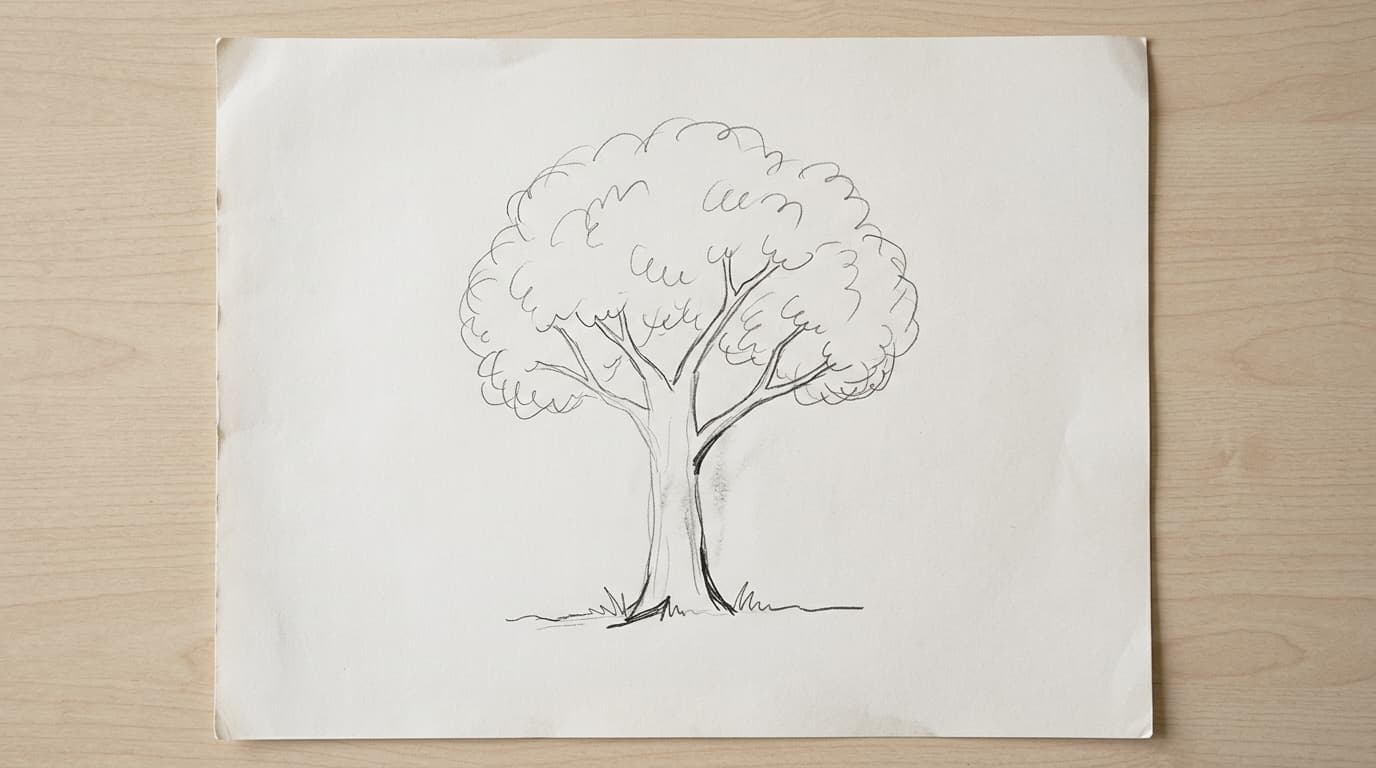
- The drawing presents a single, centrally placed tree with a balanced trunk-to-crown ratio and visible branching, rendered with continuous, deliberate lines.
- While formal features like page use and complexity can be described neutrally, they do not provide direct evidence of stable psychological traits or clinical conditions.
- The balanced composition serves as a structured starting point for personal reflection, allowing the artist to explore their own associations with stability, growth, and boundaries.
Observation before interpretation
What We Observed
- The tree is centered on the page, occupying approximately 50% of the vertical space, leaving ample white space around it.
- The drawing is placed centrally on the horizontal axis of the paper.
- The drawing shows moderate detail, including a textured trunk base, visible branching structure, a loopy crown outline, and a ground line with grass.
- The tree is drawn at a balanced scale, neither filling the entire page nor appearing excessively small.
- The lines are firm, continuous, and deliberate, with smooth curves forming the crown and clear outlines for the trunk.
- A clear branching structure is visible, with the trunk dividing into several primary and secondary branches that extend into the crown.
- The trunk and crown are balanced, with the crown being slightly larger than the trunk height, establishing a classic proportional ratio.
Whole-tree overview
The drawing features a single tree positioned centrally on the horizontal axis of the paper, utilizing approximately half of the vertical space. This balanced placement leaves a substantial amount of white space around the tree, creating a sense of containment and focus. The overall scale of the tree is moderate, avoiding the extremes of filling the entire page or appearing insignificantly small in the corner.
Rendered in graphite pencil, the drawing exhibits clear, continuous lines that define both the structural trunk and the softer, loopy crown. The clarity of the medium allows for a distinct separation between the solid, vertical trunk and the cloud-like foliage, presenting a legible and organized visual structure. There are no signs of erratic sketching or heavy, anxious shading, suggesting a deliberate and controlled drawing process.
From a whole-tree perspective, the composition is highly symmetrical and orderly, which can be interpreted in multiple ways depending on the artist's background. While some historical projective frameworks associated high symmetry with rigidity, contemporary research emphasizes that such formal features are highly dependent on artistic experience and situational context, making direct psychological inferences unreliable.
Roots and ground
At the base of the tree, a single, continuous ground line extends horizontally, anchoring the trunk to the lower portion of the page. This ground line is embellished with small, sharp tufts of grass on either side of the trunk, providing a simple environmental context. No deep, sprawling, or exposed roots are visible beneath the ground line, keeping the focus entirely on the visible, above-ground structure.
The connection between the trunk and the ground is direct and stable, with the trunk base flaring slightly outward as it meets the horizontal line. This flare suggests a natural transition from the vertical column of the trunk to the horizontal plane of the earth, establishing a clear foundation. The absence of a container or a floating base reinforces this direct connection to the ground.
The presence of a clear ground line and the absence of exposed roots can serve as a neutral starting point for reflecting on one's sense of stability and foundation. Rather than indicating a specific psychological state, this formal choice invites the artist to consider what represents their grounding forces and how they establish stability in their daily life.
Trunk
The trunk is drawn with a moderate width, rising vertically from the ground line and maintaining a consistent, solid outline. It exhibits a slight taper as it ascends, flaring gently at the base and splitting smoothly into the primary branches. The lines forming the trunk are continuous and firm, with minimal shading or internal texture, presenting a clean and uncomplicated column.
The transition from the trunk to the branching structure is seamless, with the trunk splitting into two main forks that further divide into smaller limbs. This smooth transition suggests a continuous flow of energy and structure from the base upward, maintaining the overall balance of the tree. The vertical orientation of the trunk is upright, with no significant tilt to the left or right, contributing to the symmetrical feel of the drawing.
In projective drawing literature, the trunk has historically been associated with inner strength or ego resilience, but empirical studies show no consistent correlation between trunk width or continuity and specific psychological traits. Instead of viewing the trunk as a diagnostic sign, it is more productive to reflect on the trunk as a visual representation of support and transition, raising questions about how one manages transitions between their foundation and their outward expressions.
Branches
A clear and detailed branching structure is visible within the crown, with the trunk dividing into several primary limbs that extend upward and outward. These branches further subdivide into smaller, secondary branches, creating a structured network that supports the foliage. The branches are drawn with double lines, giving them volume and a sense of physical presence rather than being simple single-line strokes.
The distribution of the branches is relatively symmetrical, spreading evenly to the left and right sides of the crown. Some branches cross over or run parallel to each other, but they generally maintain an organized, non-tangled layout that fills the interior of the crown. The branches do not appear truncated or abruptly cut off; instead, they terminate naturally within the boundary of the foliage.
The visible branching structure invites reflection on how one reaches out, expands, or connects with the external environment. Because the branches are contained within the crown rather than bursting wildly beyond it, this feature can invite a neutral exploration of how the artist balances their outward aspirations with their personal boundaries and self-imposed limits.
Crown, foliage, flowers, and fruit
The crown of the tree is represented by a large, rounded, cloud-like shape defined by a continuous series of loopy, curved lines. This loopy boundary gives the crown a soft, organic texture, contrasting with the straighter, firmer lines of the trunk and branches. The crown is the largest component of the tree, dominating the upper half of the composition and establishing a clear canopy.
Inside the crown, several smaller loopy lines are drawn, suggesting clusters of foliage and adding internal depth to the canopy. These internal loops are scattered throughout the crown, mirroring the texture of the outer boundary and reinforcing the impression of a full, healthy tree. There are no individual leaves, flowers, fruits, or falling elements depicted, keeping the foliage representation generalized and symbolic.
The large, enclosed crown can be a focal point for reflecting on one's mental space, ideas, or public persona. While some older interpretive manuals claimed that a large crown indicates intellectual ambition or fantasy, scientific reviews caution against such direct translations. Instead, the artist might reflect on the contrast between the structured branches inside and the soft, protective canopy that encloses them.
Marks and unusual elements
The trunk, branches, and crown are notably free of any unusual marks, surface events, or blemishes. There are no visible cavities, hollows, scars, knots, or broken branches drawn on the tree. The outlines of the trunk are smooth and continuous, and the interior of the trunk is left entirely blank, without any shading or texture lines that might suggest bark patterns.
Additionally, there are no attached objects such as swings, birdhouses, nests, or signs, which are sometimes found in more elaborate tree drawings. The absence of these elements keeps the drawing focused purely on the essential, organic structure of the tree itself. This clean presentation minimizes visual distractions and emphasizes the primary forms of trunk, branch, and crown.
In some clinical traditions, marks like scars or cavities were interpreted as signs of past trauma or emotional distress, but empirical evidence does not support this diagnostic leap. The absence of these marks in this drawing should not be over-interpreted as an absence of life challenges; rather, it simply highlights a formal preference for simplicity and structural clarity, which the artist can explore in relation to their own aesthetic choices.
Proportion and visual rhythm
The proportional relationship between the trunk and the crown is well-balanced, with the crown being slightly taller and wider than the trunk, but not overwhelmingly so. This ratio creates a stable center of gravity, making the tree appear physically grounded and structurally sound. The height of the trunk is sufficient to lift the crown well above the ground line, establishing a clear vertical progression.
A distinct visual rhythm is created by the contrast between the straight, vertical lines of the trunk and the repetitive, loopy curves of the crown. This rhythm is balanced by the branching structure, which acts as a transitional element, carrying the straight lines of the trunk into the curved space of the canopy. The generous whitespace surrounding the tree enhances this rhythm, allowing the tree's silhouette to stand out clearly.
Reflecting on the proportion and rhythm of the drawing can help the artist explore their personal sense of balance. The harmonious relationship between the trunk (support) and the crown (expression) can serve as a metaphor for how they balance different aspects of their life, such as work and leisure, or internal thoughts and external actions, without implying any fixed psychological trait.
Tree and environment
The tree is depicted in a highly simplified environment, with only the horizontal ground line and a few tufts of grass indicating its physical setting. There are no other plants, trees, flowers, or landscape features like mountains or water bodies. This minimal context isolates the tree, making it the sole focus of the viewer's attention.
Furthermore, there are no weather elements, such as a sun, clouds, rain, or wind, nor are there any animals, birds, or buildings. The absence of these environmental details creates a neutral, timeless setting, free from specific narrative or seasonal context. The tree exists in a quiet, self-contained space on the page.
This environmental simplicity can be a starting point for reflecting on how the artist perceives their relationship with their surroundings. Drawing a tree in isolation might reflect a desire to focus on self-exploration, or it may simply be an artistic choice to keep the drawing clean and uncomplicated. The lack of environmental stressors (like wind or rain) allows the artist to contemplate their inner state in a calm, undisturbed context.
Integrated reflection
Integrating the vertical sequence of the drawing—from the stable ground line and grass, up through the solid, upright trunk, into the structured branches, and finally to the soft, loopy crown—reveals a cohesive and harmonious composition. Each part of the tree transitions smoothly into the next, creating a unified whole that represents a classic, balanced depiction of a tree. This vertical flow suggests a natural progression from foundation to growth and expression.
Alternative interpretations of this balanced composition should always be considered. While one person might view the symmetry and containment as a sign of order and peace, another might see it as a preference for safety and conventionality. These different perspectives highlight that a drawing is not a fixed psychological test with a single correct answer, but rather a mirror for the artist's current thoughts and feelings.
Ultimately, the drawing serves as a highly personalized canvas for self-reflection. By examining the choices made—such as the central placement, the visible branches, and the lack of external environment—the artist can engage in a meaningful dialogue with themselves. This process of self-inquiry is the most valuable aspect of the drawing, far outweighing any standardized psychological interpretation.
Reflection Questions
- What does the balance between the solid trunk and the soft, loopy crown suggest to you about your own balance between structure and flexibility?
- How do you feel about the tree being drawn in isolation, without other elements like the sun, clouds, or other trees?
- What thoughts or feelings arise when you look at the visible branches contained within the protective canopy of the crown?
- Does the simple ground line with grass tufts feel like a secure foundation to you, or do you feel a desire to add deeper roots?
- If you were to add one more element to this drawing (a bird, a swing, a path, or weather), what would it be, and what might that represent?
Research and Methodology
Evidence strength: The scientific evidence supporting the use of tree drawings for individual psychological assessment is highly limited and contradictory. While some studies identify group-level statistical associations between specific drawing features and cognitive or emotional states, these findings do not translate reliably to individual assessments due to high variability in artistic skill, cultural background, and situational factors.
Limitations
- Group-level associations do not establish a reliable basis for individual psychological interpretation or diagnosis.
- Artistic experience, motor skills, and the specific drawing materials used can significantly influence the formal features of the drawing, independent of psychological factors.
- The administration and scoring of projective drawing tests lack universal standardization, leading to inconsistent results across different settings.
Conflicting or null findings
- Some clinical studies suggest correlations between drawing features and cognitive impairment or depressive symptoms, whereas comprehensive meta-analyses and reviews highlight severe methodological limitations and caution against using these techniques for diagnostic purposes.