Sample Report - Example Only
Silver Drawing Test
This example shows the structure and evidence limits of a complete InnerCanvas report. It is not an assessment of the viewer.

Quick Read
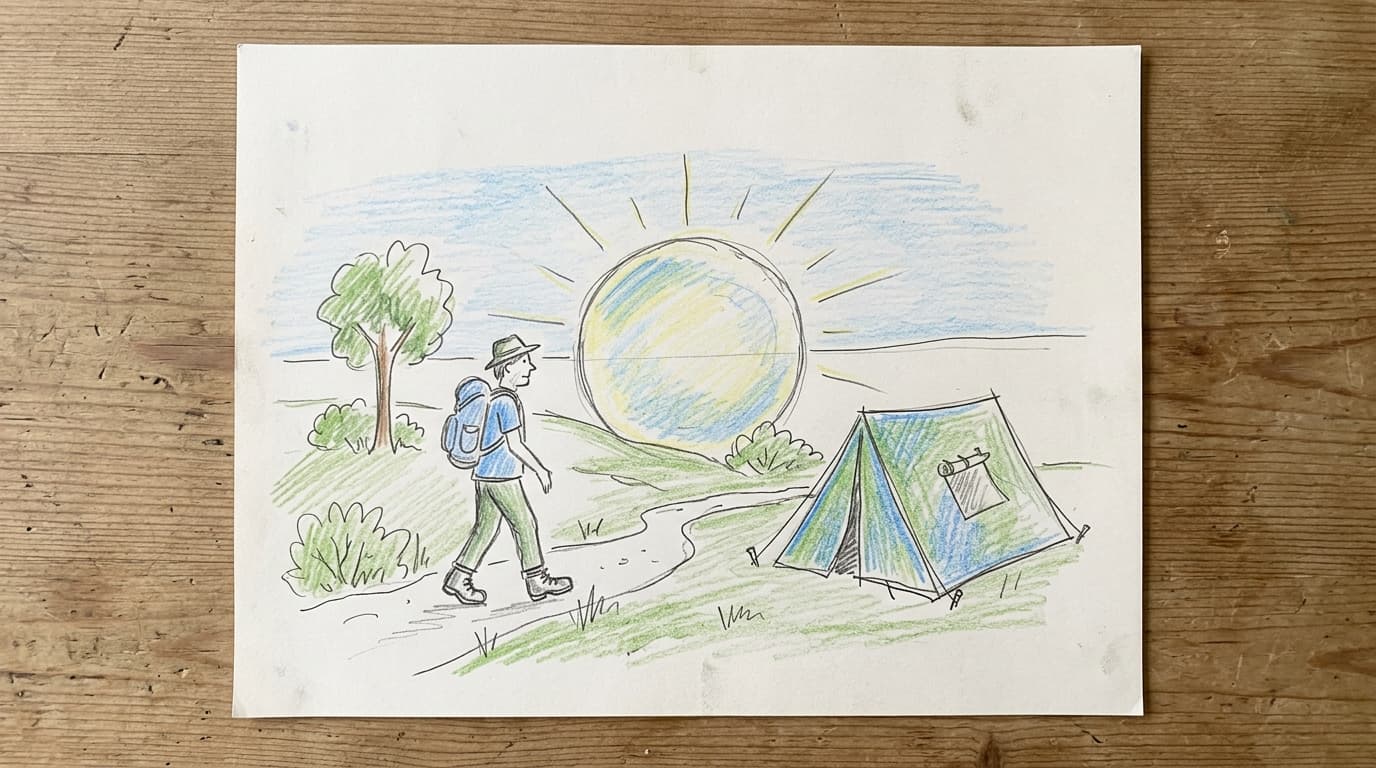
- The drawing depicts a hiker walking along a path toward a tent under a large, central sun, demonstrating a highly integrated narrative scene.
- The use of a balanced color palette and detailed elements like the hiker's gear and the tent's structure shows careful composition and attention to detail.
- While the scene is rich in narrative and spatial organization, formal features should be used to invite self-reflection rather than to infer stable psychological traits or diagnoses.
Observation before interpretation
What We Observed
- The drawing occupies the majority of the page, with a balanced layout featuring a central sun, a hiker on the left, a path winding through the center, and a tent on the right.
- Visible colors include blue (sky, shirt, backpack, tent), green (pants, grass, tree, bushes), yellow (sun), brown (tree trunk, boots, hat, path), and black outlines.
- The drawing contains narrative elements: a hiker with a backpack, a winding path, a tent, a large sun, a tree, and bushes.
- The hiker is depicted in mid-stride, walking along the path towards the tent, suggesting movement or a journey.
- The drawing shows moderate detail, including individual blades of grass, shading on the tent, a rolled-up window on the tent, laces on the boots, and rays emanating from the sun.
- The sun is depicted as very large relative to the hiker and the tent, occupying a central position on the horizon.
- The elements (hiker, path, tent, sun, landscape) are integrated into a cohesive scene representing an outdoor camping or hiking scenario.
Completed tasks and materials
The drawing presents a fully realized, integrated scene that aligns with the Drawing from Imagination or Story subtest of the Silver Drawing Test. It features a hiker, a winding path, a tent, and a large sun, which together form a cohesive narrative landscape.
The materials used appear to be colored pencils and a black fine-liner or pencil for outlining on a standard sheet of white paper, allowing for a clear definition of shapes and a varied color palette.
No other subtests, such as Drawing from Observation or Predictive Drawing, are visible in this specific image, meaning the analysis is focused entirely on this single imaginative composition.
Drawing from observation
Although the formal Drawing from Observation subtest is not present, the artist's observational skills are reflected in the realistic rendering of the landscape elements, such as the tree, bushes, and tent.
The proportions and spatial relations of the drawn objects show a clear understanding of perspective, with the path narrowing as it recedes toward the horizon and the hiker positioned in the foreground.
Predictive drawing
The Predictive Drawing subtest is absent, but predictive elements can be hypothesized from the hiker's direction of movement along the path toward the tent.
The sequence of events is implied by the path's trajectory, suggesting the hiker will eventually reach the tent as the sun sets or rises, establishing a temporal sequence.
Drawing from imagination or story
The drawing represents a rich narrative from imagination, depicting a camping trip or outdoor adventure with a clear setting, character, and implied plot.
The character of the hiker is detailed with a backpack, hat, and boots, walking towards a pitched tent, which serves as the central narrative anchor of the scene.
The large sun on the horizon adds a dramatic backdrop, framing the story within a specific time of day, either sunrise or sunset, which enhances the imaginative quality of the scene.
Stimulus choice and transformation
The integration of various stimuli (the human figure, the tent, the sun, and the natural landscape) demonstrates a creative transformation of individual concepts into a unified composition.
Rather than drawing isolated objects, the artist has modified and connected them through the winding path, which physically and conceptually links the hiker to the tent and the horizon.
Spatial relations and sequence
Spatial relations are clearly defined, with the hiker on the left side of the path, the tent on the right, and the sun positioned centrally in the background, creating a sense of depth and distance.
The sequence of movement is indicated by the hiker's posture and the direction of the path, suggesting a progression from the foreground (before) to the tent in the midground (after).
Conceptual and narrative organization
The objects form an understandable, cohesive scene where each element plays a functional role in the narrative of a journey or outdoor stay.
The conceptual organization is achieved without relying on rigid or disjointed placements, showing a fluid integration of the hiker, the path, the tent, and the environment.
Emotional content and self-representation
The tone of the drawing is peaceful and adventurous, supported by the bright yellow sun, green foliage, and the active but relaxed posture of the hiker.
While some might interpret the solitary hiker as representing independence or isolation, research cautions against drawing stable psychological or diagnostic conclusions from these formal features alone.
The choice of a camping scene invites personal reflection on the artist's relationship with nature, travel, or solitude, rather than serving as a diagnostic indicator.
Cross-task comparison
Because only one completed subtest (the imaginative/narrative drawing) is visible in the provided image, a direct cross-task comparison with observation or prediction subtests cannot be fully realized.
However, the single scene itself demonstrates a high level of internal consistency, combining elements of observation (realistic rendering of a tent and figure) with imagination (the stylized large sun and narrative path).
Integrated reflection
The drawing presents a rich canvas for self-reflection, raising questions about the hiker's destination, the time of day, and the feelings associated with a solitary journey.
The prominent, oversized sun invites exploration of what this central, bright element represents to the artist, whether it symbolizes a new beginning, warmth, or a guiding light.
Ultimately, the drawing serves as a starting point for dialogue and personal exploration, emphasizing the subjective meaning of the creative process over standardized psychological profiling.
Reflection Questions
- What does the journey of the hiker along this winding path represent to you in your current life stage?
- How do you feel when looking at the large, central sun—does it feel like a rising sun of new beginnings or a setting sun of completion?
- What is the significance of the tent in this drawing; does it represent a safe haven, a temporary rest stop, or something else?
- If the hiker could speak, what would they say about where they are coming from and where they are going?
- How does the choice of colors (the blues, greens, and yellows) reflect your current emotional state or preferences?
- What elements of this scene, if any, feel most connected to your personal experiences or memories of nature?
Research and Methodology
Evidence strength: The evidence supporting the interpretation of drawing features is limited and highly context-dependent, with critical reviews emphasizing the lack of support for stable psychological trait inferences from single drawings.
Limitations
- Culture and administration context materially constrain the transfer of standardized norms.
- Local norms, such as those from Brazilian or cross-cultural studies, do not generalize globally to individual adult drawings.
- The scientific status of projective techniques supports restraint and limitation language rather than positive diagnostic rules.
Conflicting or null findings
- Some clinical studies report group-level associations with specific drawing features, whereas critical meta-analyses find insufficient evidence to support individual classification or diagnostic inferences.