Sample Report - Example Only
Person Picking an Apple from a Tree (PPAT)
This example shows the structure and evidence limits of a complete InnerCanvas report. It is not an assessment of the viewer.

Quick Read
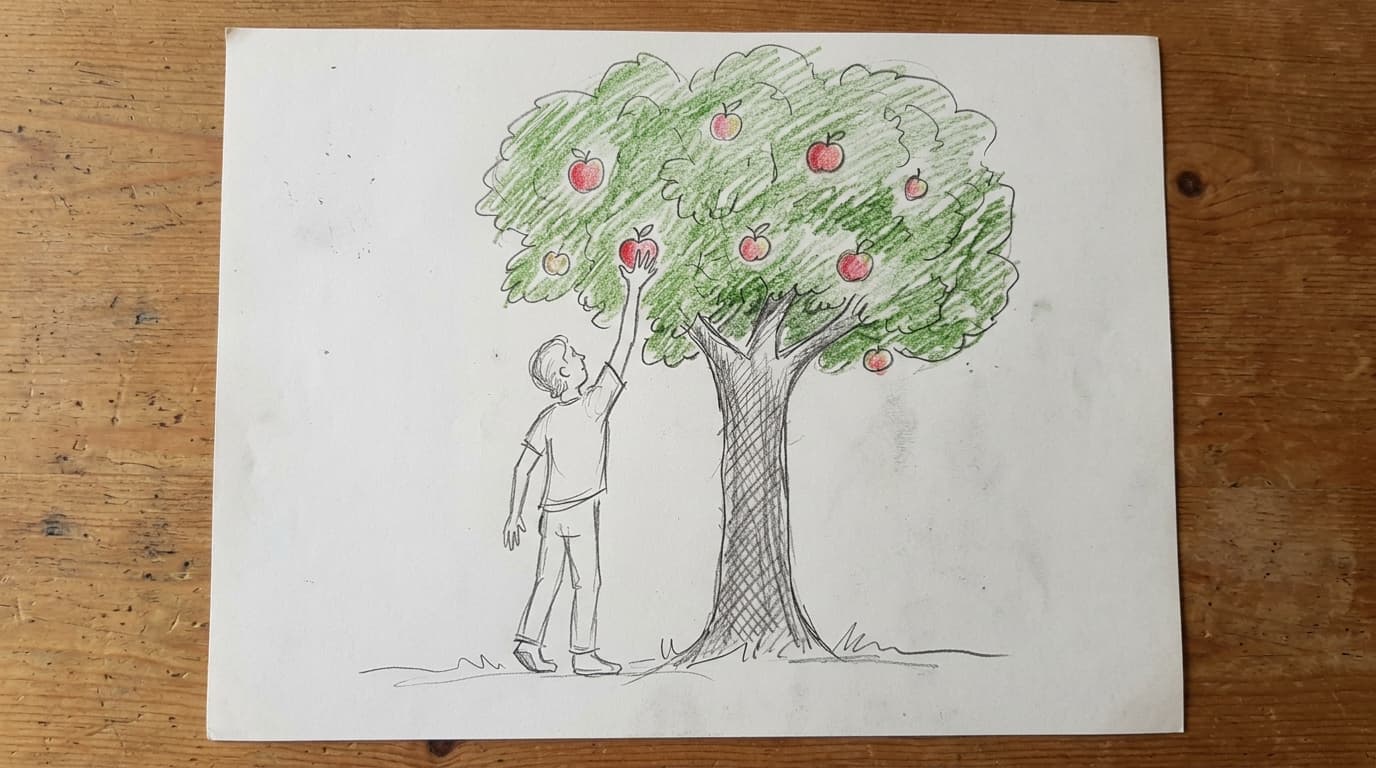
- The drawing depicts a complete human figure standing on a ground line and reaching up to touch one of several apples in a large, green-canopied tree.
- The physical contact between the person's hand and the apple represents a direct, active strategy of goal pursuit without the use of external tools.
- While the formal features of the drawing are highly organized and detailed, they serve as starting points for personal reflection rather than diagnostic evidence of psychological traits or clinical conditions.
Observation before interpretation
What We Observed
- A complete human figure is depicted in a three-quarter back/side view, showing head, torso, limbs, and clothing (t-shirt and pants), standing on a ground line.
- A complete tree is drawn with a textured, cross-hatched trunk, visible root base on the ground line, and a large green-colored canopy.
- Multiple red and yellow-red apples are distributed throughout the tree's canopy, with one specific red apple positioned directly at the fingertips of the person's raised hand.
- The person's right arm is fully extended upward, with the hand making direct contact with a red apple in the lower-left section of the tree canopy.
- The tree is approximately twice the height of the standing person, presenting a realistic scale relationship between the actor and the environment.
- The drawing is centered on the landscape-oriented page, utilizing the middle horizontal band with balanced margins on all sides.
- The drawing features detailed pencil work including cross-hatching on the trunk, individual fingers, clothing folds, grass tufts, and colored pencil shading for the green canopy and red apples.
Goal-directed scene overview
The drawing presents a landscape-oriented composition featuring a complete human figure on the left and a large, green-canopied tree on the right, both grounded on a single horizontal line. The person is depicted in a three-quarter back/side view, actively extending their right arm upward to make direct contact with a red apple hanging from the lower-left section of the tree's canopy. This arrangement establishes a clear, active narrative of goal pursuit, where the actor is physically engaged with the environment to reach a specific object.
The composition utilizes the horizontal space of the page effectively, placing the tree as the dominant vertical element and the person as the active agent. The balanced margins and central placement of the main subjects create a structured and organized visual field. While this formal layout provides a clear framework for analyzing the drawing's narrative, research emphasizes that such compositional choices are highly influenced by individual artistic preferences and situational factors, rather than serving as direct indicators of stable psychological traits.
Person
The human figure is drawn with a high level of completeness, showing a clear outline of the head, torso, limbs, and clothing, including a short-sleeved t-shirt and long pants. The figure is positioned in a three-quarter view from behind, with the head turned slightly to the right to look up at the apple. The right arm is fully extended upward, with individual fingers rendered as they touch the apple, while the left arm hangs relaxed at the side, and both feet are planted firmly on the ground line.
The grounding of the figure on a clear horizontal line suggests a stable physical presence within the depicted environment. The absence of any drawing errors or missing body parts indicates a detailed and careful execution of the human form. However, contemporary reviews of projective drawing techniques caution that the level of detail and completeness in human figure drawings is primarily a reflection of drawing ability and developmental factors, and cannot be used to make reliable inferences about an individual's self-esteem or psychological adjustment.
Tree
The tree is depicted as a large, robust structure with a thick trunk that features detailed cross-hatched pencil shading, suggesting texture and volume. The base of the trunk flares out slightly to form visible roots that rest on the ground line, and the trunk splits into several main branches that extend into the canopy. The canopy itself is a large, rounded shape colored with green colored pencil, using loose, circular strokes to represent foliage, and contains several red and yellow-red apples.
The structural completeness of the tree, from the roots to the branches and canopy, provides a strong visual anchor for the scene. The detailed rendering of the trunk and the vibrant coloring of the canopy contribute to a sense of environmental stability. Despite historical claims linking tree drawings to the creator's inner strength or psychological stability, scientific evidence shows that these formal features are highly variable and context-dependent, making them unsuitable for individual diagnostic purposes.
Apple or visible goal object
A total of approximately nine apples are distributed throughout the tree's canopy, rendered in red and yellow-red colored pencil. One specific red apple is positioned at the lower-left edge of the canopy, directly at the fingertips of the person's fully extended right hand. The other apples are scattered across different heights and sections of the canopy, remaining untouched and hanging within the green foliage.
The apple being touched is the lowest and most accessible of the red apples, establishing a direct link between the actor's reach and the goal. The presence of multiple other apples suggests a resource-rich environment with alternative options. While the choice of a specific apple and the state of touching it can be a meaningful starting point for personal reflection, there is no empirical support for interpreting the number or placement of apples as a measure of an individual's motivation or goal-directed drive.
Reaching and action chain
The action chain is defined by a direct, upward reach where the person's right arm is fully extended, creating a continuous line from the shoulder to the fingertips touching the apple. The body remains upright and grounded, indicating that the reach is achieved through physical extension rather than climbing or jumping. This direct physical connection between the hand and the apple represents a completed action of reaching, where the goal is actively engaged.
The clarity of the reaching action highlights a straightforward strategy for goal attainment, where the actor directly interacts with the object of interest. While this visual representation of action is a central feature of the PPAT assessment, research indicates that the depiction of reaching or touching an apple cannot be used to predict an individual's actual problem-solving strategies or attachment security in real-world relationships.
Scale, distance, and accessibility
The spatial relationship between the person and the tree is characterized by close proximity, with the person standing just to the left of the trunk. The tree is approximately twice the height of the standing figure, creating a realistic scale where the lower branches and canopy are within the physical reach of the person. This proportion allows the person to touch the target apple with their arm fully extended, making the goal highly accessible from a standing position.
The direct accessibility of the apple, due to the realistic scale and close distance, suggests a scenario where the goal is within reach without extraordinary effort or risk. While this spatial arrangement can be a useful starting point for reflecting on how one perceives the accessibility of their own goals, scientific literature cautions that drawing proportions and distances are heavily influenced by artistic skill and do not reliably reflect psychological distance or perceived difficulty.
Resources, obstacles, and environment
The environment in which the action takes place is minimally depicted, consisting of a single horizontal ground line with small, simple grass tufts drawn near the base of the tree and the person's feet. There are no external tools, such as a ladder or a basket, and no other environmental elements like weather, additional people, or animals. The focus remains entirely on the direct interaction between the single person and the tree.
The lack of external resources or obstacles simplifies the narrative, emphasizing self-reliance and direct physical effort. This minimalist environmental context is a common feature in normative drawing samples and should not be interpreted as a sign of social isolation, lack of support, or psychological distress, as such clinical inferences are not supported by empirical evidence.
Formal organization
The drawing demonstrates a high level of formal organization, characterized by clean pencil outlines, detailed cross-hatching on the tree trunk, and the selective use of colored pencils to fill in the canopy and apples. The integration of these elements creates a visually appealing and complete scene, where the use of color draws immediate attention to the tree and the apples, while the person remains uncolored but highly detailed.
The careful execution of details, such as the individual fingers touching the apple and the folds in the clothing, indicates a high level of engagement with the drawing task. However, formal features like color choice, line quality, and detail complexity are highly dependent on the drawing materials provided, the instructions given, and the creator's artistic background, meaning they cannot be used as standardized measures of cognitive or emotional functioning.
Goal-directed scene integration
The scene successfully integrates the actor, the goal object, and the strategy of direct reaching into a coherent and balanced narrative. The current result of the action is a moment of contact, where the person's hand is actively touching the apple, representing a successful connection between effort and goal. This integration of elements provides a clear visual story of active engagement with the environment.
The depiction of a successful reach suggests a positive outcome within the context of the drawing. However, this visual representation is a creative expression and does not provide a scientifically validated prediction of how the creator approaches goals, handles obstacles, or experiences success in their daily life, highlighting the importance of avoiding overstatements in projective drawing analysis.
Integrated reflection
The drawing captures a specific, transitional moment—the instant of contact between the hand and the apple—which invites the creator to reflect on the sequence of events. One might consider what happens next: will the person pluck the apple, eat it immediately, or perhaps share it with others? These questions encourage the creator to explore their own desires, expectations, and narratives surrounding goal attainment.
Exploring alternative scenarios, such as what the scene would look like if a ladder were used or if the person chose a different apple, can help the creator uncover personal meanings and preferences. These reflections are valuable for self-awareness, but they must remain client-led, as the drawing itself does not contain objective psychological data that would allow for clinical diagnoses or personality assessments.
Reflection Questions
- What does the moment of touching the apple, rather than holding or eating it, represent to you?
- How do you feel about the person relying solely on their own reach without any tools like a ladder or basket?
- What might happen next in this scene once the apple is touched?
- How does the size of the tree relative to the person reflect your view of the challenges or goals in your life?
- If you were to add other elements to this environment, such as other people or weather, what would they be?
Research and Methodology
Evidence strength: The evidence supporting the psychological interpretation of individual drawing features is limited and often contradictory. While group-level associations have been explored in research, they do not translate to reliable individual assessments.
Limitations
- Most studies rely on small convenience samples or specific clinical populations.
- Artistic skill, cultural background, and drawing materials are significant confounding factors.
- Individual drawing features cannot be used to reliably predict stable personality traits or clinical diagnoses.
Conflicting or null findings
- Some historical frameworks suggest specific meanings for drawing details, whereas comprehensive reviews find little scientific support for these projective interpretations.
- Attachment studies show group-level correlations with drawing features, but these cannot be used to classify an individual's attachment style.