Sample Report - Example Only
Person-in-the-Rain
This example shows the structure and evidence limits of a complete InnerCanvas report. It is not an assessment of the viewer.

Quick Read
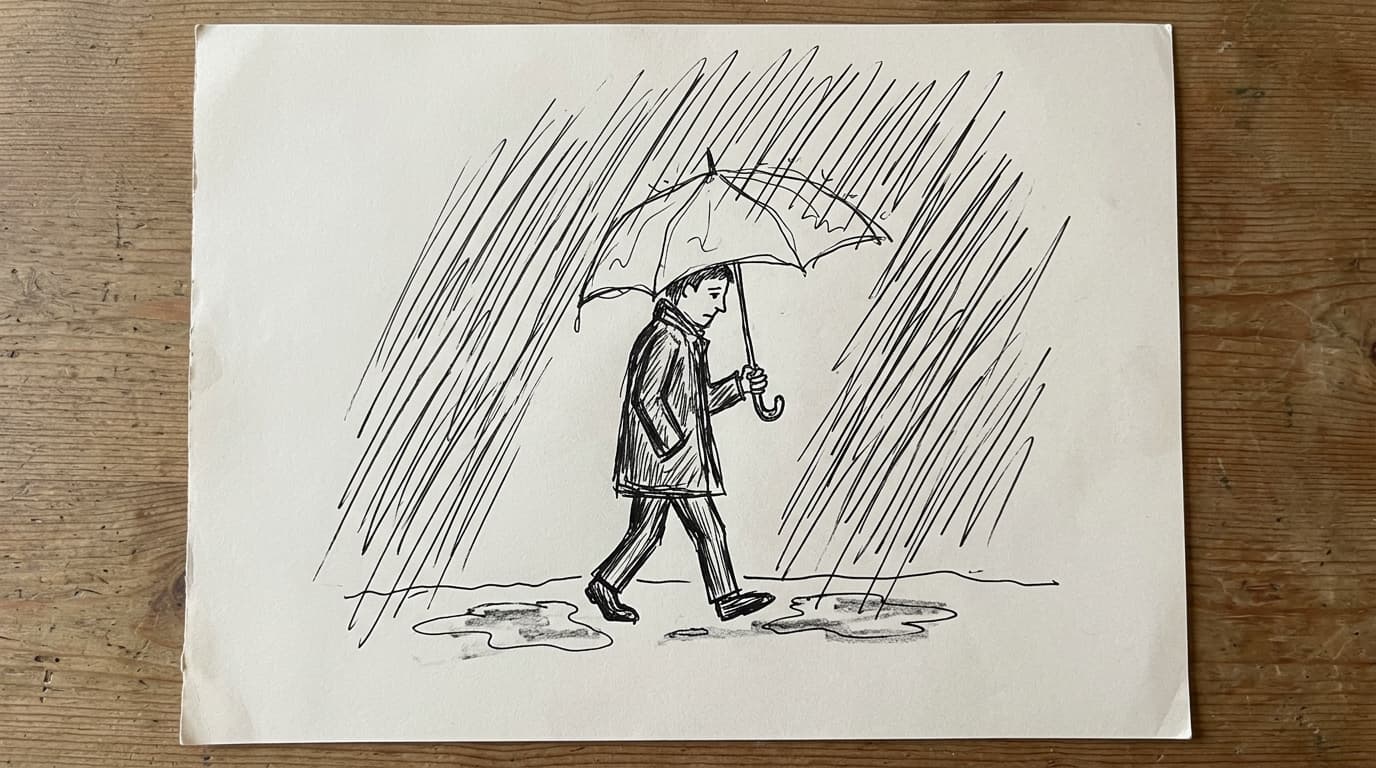
- The drawing is centrally positioned on the page, featuring a fully drawn human figure walking from left to right, which establishes a balanced composition and a clear narrative flow.
- The environmental conditions are characterized by dense, diagonal rain slanting from top-right to bottom-left, and a ground line marked by two distinct puddles, indicating a highly detailed depiction of a wet environment.
- The figure is equipped with visible protective resources, including a large open umbrella and a long-sleeved coat, which shield the upper body while leaving the lower limbs exposed to the elements.
- These formal features are presented as neutral observations to facilitate self-reflection, as scientific evidence does not support using individual drawing elements for diagnostic or clinical assessments.
Observation before interpretation
What We Observed
- The drawing is centrally positioned on the page, with the figure and rain elements occupying approximately 60% of the horizontal and 80% of the vertical space.
- A horizontal ground line is drawn across the lower portion of the page, featuring two distinct puddles with shaded water texture.
- The human figure is fully drawn, including a head, facial features, torso, limbs, hands, and feet, wearing a coat and trousers.
- The figure is depicted in profile, walking from left to right, with the head tilted slightly downward, one hand in a coat pocket, and the other holding an umbrella.
- An open umbrella is held above the figure's head, and the figure is wearing a long-sleeved coat that appears to offer physical coverage.
- The rain is depicted as long, parallel diagonal lines slanting from the top-right toward the bottom-left.
- The rain lines are dense, closely spaced, and cover almost the entire upper and middle sections of the drawing, indicating heavy precipitation.
Rain scene overview
The drawing presents a cohesive and structured scene where a fully drawn human figure is positioned centrally on the page, walking from left to right. The composition is well-balanced, utilizing the available space to depict both the figure and the surrounding environment in detail. The presence of dense diagonal rain and a ground line with puddles establishes a clear narrative of transit through a storm, where the figure is actively moving forward while holding an open umbrella.
This visual narrative provides a rich foundation for self-reflection, allowing the creator to explore how they perceive the relationship between the walking figure, the protective umbrella, and the heavy rain. Rather than serving as a direct measure of psychological traits, the overall composition acts as a neutral canvas for personal storytelling and exploration of one's current life context.
Rain and weather
The weather in the drawing is characterized by dense, parallel diagonal lines that slant from the top-right toward the bottom-left, covering almost the entire upper and middle sections of the page. This dense patterning indicates heavy precipitation, creating a strong visual representation of an active storm. The uniform slant of the rain lines suggests a consistent wind direction, adding a dynamic quality to the environmental conditions depicted in the scene.
While the intensity and direction of the rain are prominent, there are no explicit clouds, lightning, or other atmospheric elements drawn. This focus on the rain itself highlights the immediate physical impact of the precipitation on the figure's journey. Research indicates that the depiction of heavy rain is highly context-dependent and should not be interpreted as a direct measure of environmental stress or anxiety, but rather as an artistic choice that invites reflection on how one experiences challenging conditions.
Person
The human figure is fully drawn and centrally positioned, showing a high level of completeness with a head, visible facial features, torso, limbs, hands, and feet. The figure is depicted in profile, walking from left to right, which gives the character a sense of active movement and direction. The head is tilted slightly downward, and the visible facial features show a neutral or slightly downcast expression, suggesting a focused or contemplative state of mind during the walk.
The figure's clothing consists of a long-sleeved coat and trousers, which are drawn with clear lines and shading, adding to the completeness of the representation. The posture, with one hand tucked into the coat pocket and the other holding the umbrella, depicts a solitary and self-contained figure. These details are valuable starting points for self-reflection regarding how one represents oneself in relation to others and the environment, rather than indicators of clinical conditions or personality traits.
Visible protection and resources
The figure is equipped with two primary protective resources: a large, open umbrella and a long-sleeved coat. The umbrella is held directly above the figure's head, with its canopy extending wide enough to cover the upper torso. The coat is drawn with a high collar and long sleeves, providing a physical barrier against the elements. These resources are clearly integrated into the figure's action, showing a practical response to the wet weather conditions.
The depiction of these protective elements highlights the presence of resources within the drawing. However, the effectiveness or psychological meaning of these resources cannot be universally standardized. The presence of an umbrella or protective clothing is highly influenced by artistic experience, instructions, and cultural context, and should be explored through open-ended questions rather than scored as a measure of coping capacity.
Exposure and coverage
The spatial relationship between the rain, the umbrella, and the figure shows a clear division of exposure. The umbrella is positioned directly overhead, effectively blocking the diagonal rain lines from contacting the figure's head and upper body. This creates a protected zone immediately beneath the canopy, demonstrating a functional alignment between the protective resource and the environmental condition.
Despite the overhead protection, the lower portion of the figure, including the legs and feet, remains exposed to the diagonal path of the rain and the wet ground. This partial exposure is a realistic depiction of walking in a storm, where complete protection is difficult to achieve. This feature serves as a neutral starting point to reflect on how one manages partial protection or unavoidable exposure in challenging situations, without drawing diagnostic conclusions about vulnerability.
Action, direction, and goal
The figure is depicted in active motion, walking from left to right across the page. This forward movement is indicated by the parted legs, the forward-leaning posture, and the direction of the feet. The left-to-right direction is a common narrative convention that suggests progress, transition, or a journey from a starting point toward a destination.
The drawing does not include a visible destination, such as a building, shelter, or end path, leaving the goal of the journey open to interpretation. The figure walks steadily through the rain without a clear final point in sight. This lack of a depicted goal provides an excellent opportunity for the creator to reflect on their own sense of direction, purpose, and the nature of their current transitions, free from clinical assumptions.
Ground and environmental resources
A continuous ground line is drawn across the lower portion of the page, providing a solid physical foundation for the walking figure. This ground line prevents the figure from appearing suspended in space, establishing a realistic physical context. Two distinct puddles are drawn on the ground, with horizontal shading indicating accumulated water, which enhances the detail and realism of the wet environment.
The presence of puddles on the ground line adds a layer of environmental complexity, as the figure must navigate both the falling rain and the wet ground. The ground is depicted not just as a flat line but as an active part of the environment that interacts with the weather. This detailed ground environment serves as a neutral visual element to invite reflection on how one navigates the immediate, practical challenges in their surroundings.
Environment-resource-action integration
Integrating the elements of the drawing reveals a structured relationship between the environment, resources, and action. The environment-condition is defined by dense, diagonal rain and a wet ground line with puddles. The visible-resource consists of an open umbrella and a protective coat. The person-action is the steady, forward walking motion from left to right. The current-result is that the figure is successfully navigating the wet environment, with the upper body shielded from the downpour while the lower body remains exposed to the wet ground.
This integration is presented as a neutral observation of the drawing's structural elements, strictly avoiding any scoring of coping capacity, resilience, or psychological vulnerability. Scientific literature cautions against using these integrated features to make diagnostic inferences about an individual's ability to handle stress. Instead, the relationship between the storm, the umbrella, and the walk serves as a safe, non-diagnostic metaphor for personal reflection.
Integrated reflection
The drawing provides a rich, multi-layered visual metaphor that can be used to facilitate self-reflection and personal insight. By examining the relationship between the heavy rain, the protective umbrella, the coat, and the steady walk, the creator can explore their own feelings about challenges, resources, and transitions in their life. This process is entirely self-directed, allowing the creator to assign their own meaning to each element.
Because projective drawing features are highly subjective and influenced by many non-psychological factors, there is no single 'correct' interpretation of this scene. The drawing is best understood as a personal narrative and a starting point for dialogue, rather than a standardized test. The creator is encouraged to consider what these choices meant to them during the drawing process, using the visual elements as a safe space for self-discovery.
Reflection Questions
- How does the person in the drawing feel about the heavy rain falling around them?
- Where is the figure walking to, and what awaits them at their destination?
- How effective do you feel the umbrella and coat are in protecting the figure from the storm?
- What do the puddles on the ground represent to you, and how does the figure navigate them?
- If you could add one more resource or element to this drawing to help the figure, what would it be?
- How does the direction and intensity of the rain affect the figure's journey?
Research and Methodology
Evidence strength: Limited and contradictory. While some studies suggest group-level correlations between drawing features and psychological states, comprehensive reviews indicate that individual projective drawings cannot be reliably used for diagnostic or predictive purposes.
Limitations
- Small, culturally specific sample sizes in existing research limit generalizability.
- Drawing features are highly influenced by artistic skill, materials, and instructions.
- Cross-sectional studies cannot establish causal relationships or stable personality traits.
Conflicting or null findings
- Some art therapy scales attempt to quantify coping capacity based on protection features, whereas major psychological reviews caution against using these features for individual diagnostic inferences.