Sample Report - Example Only
Kinetic House-Tree-Person (K-H-T-P)
This example shows the structure and evidence limits of a complete InnerCanvas report. It is not an assessment of the viewer.

Quick Read
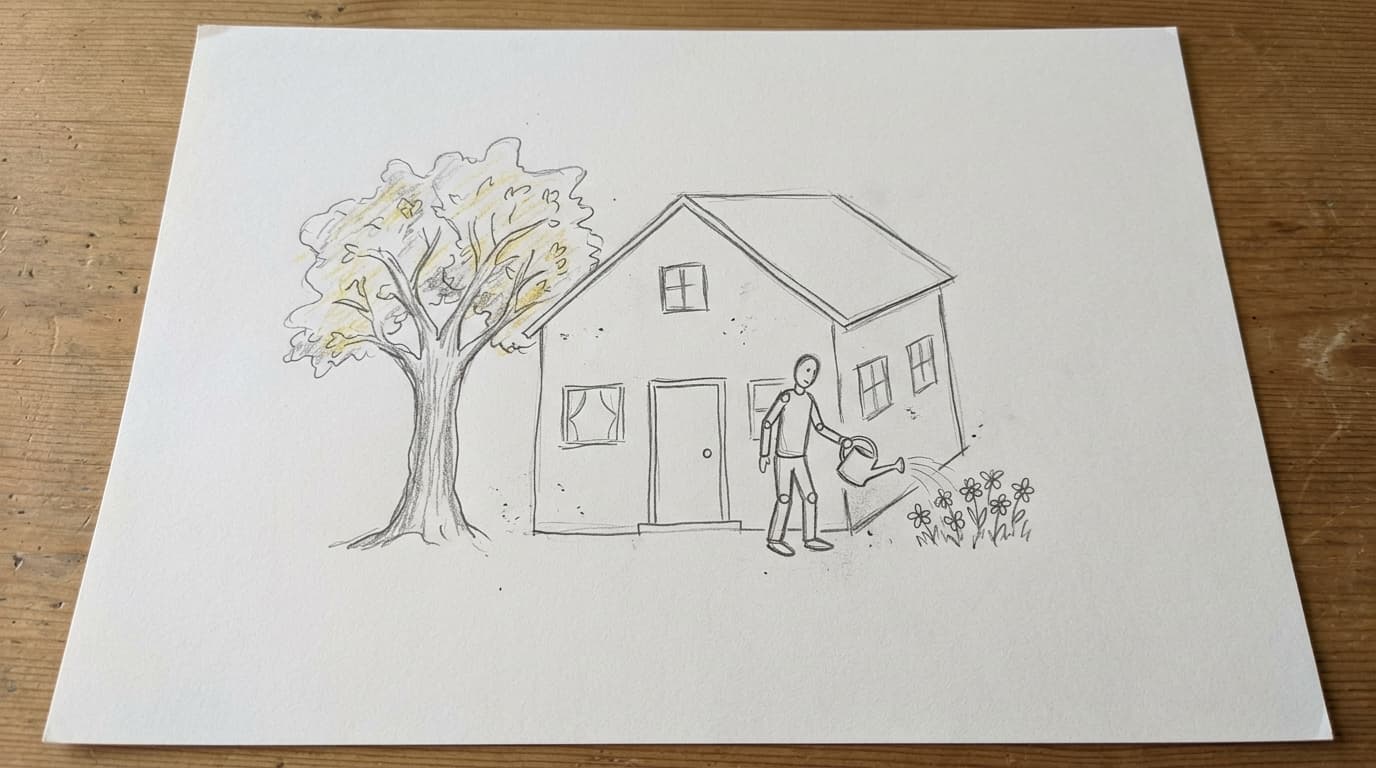
- The drawing features a complete, stylized jointed figure actively watering a patch of flowers next to a house, establishing a clear kinetic theme of caretaking and growth.
- A large tree with vertical trunk lines and yellow-shaded foliage stands on the left side of the house, providing a visual balance and a unique colored element in the composition.
- The house is depicted with moderate detail, including a pitched roof, a curtained window, and side windows in perspective, serving as a stable central backdrop to the outdoor action.
- While the spatial arrangement and active theme are visually clear, empirical research emphasizes that these features are highly context-dependent and cannot be used to infer stable psychological traits or clinical diagnoses.
Observation before interpretation
What We Observed
- A house with a pitched roof, a front door with a doorknob, a curtained window on the left, a small square window above the door, and two windows on the right side wall showing perspective.
- A tree on the left side of the house with a textured trunk, spreading roots, branches, and a crown shaded with yellow/orange colored pencil.
- A stylized jointed figure standing to the right of the front door, holding a watering can.
- The person is watering a small patch of flowers on the right side of the house, with visible water lines coming from the watering can.
- The drawing is centered horizontally on the page, with the tree on the left, the house in the middle, and the person and flowers on the right.
- The elements are spaced out horizontally across the middle of the page, with the tree close to the house and the person standing close to the house's right corner.
- The drawing features moderate detail, including window curtains, jointed limbs on the person, individual flower petals, and colored shading on the tree.
Kinetic scene overview
The drawing depicts a stylized, jointed person standing outside a house, holding a watering can and actively watering a small patch of flowers, while a large tree with yellow-shaded foliage stands to the left of the house.
This kinetic scene establishes a clear narrative of domestic care and environmental interaction, where the human figure is positioned as an active agent within a structured outdoor setting.
House
The house is drawn with a clear two-dimensional facade showing a pitched roof, a central front door with a doorknob, a curtained window on the left, a small square window above the door, and two windows on the right side wall indicating a three-quarter perspective. The structure is solid and lacks a chimney or a defined pathway leading to the door, presenting a self-contained architectural form.
The presence of curtains in the left window and the multi-pane design of the side windows suggest attention to domestic detail, while the lack of a path or steps leaves the house's connection to the surrounding ground somewhat abstract. This structural presentation can be viewed as a neutral representation of a home, inviting reflection on how the artist perceives domestic spaces without serving as direct evidence of specific psychological traits.
In the context of the overall scene, the house serves as a central backdrop to the action, defining the boundary between the indoor domestic sphere and the outdoor natural environment where the activity takes place. The absence of complex environmental details like fences or pathways highlights the simplicity of the setting, which is a common variation in projective drawings and does not warrant diagnostic conclusions.
Tree
The tree is positioned on the left side of the page, featuring a thick trunk with vertical bark lines, roots that spread out at the base to meet the ground, and branches that extend into a large, rounded crown. The foliage is shaded with a light yellow or orange colored pencil, contrasting with the pencil-drawn lines of the rest of the scene.
The spreading roots suggest a stable connection to the ground, while the vertical lines on the trunk add texture and detail to the structure. The yellow shading in the crown is the only colored element in the drawing, drawing visual attention to the tree's foliage and suggesting a specific seasonal or aesthetic choice by the artist.
While some historical projective interpretations might assign symbolic meaning to the tree's roots or colored foliage, empirical research indicates that such features are highly dependent on artistic preference, available materials, and individual context rather than stable personality traits. The tree stands as a natural element balancing the architectural presence of the house, providing a neutral starting point for the artist to reflect on their relationship with nature.
Person
The person is depicted as a stylized, jointed figure reminiscent of an artist's wooden mannequin, with circular joints at the shoulders, elbows, hips, and knees. The figure is complete, standing upright, and oriented towards the right, holding a watering can with both hands to water the flowers.
The figure's posture is active yet stable, with the legs slightly apart and the arms extended forward to support the watering can. The facial features are minimal, consisting of simple dots for eyes and a small line for a mouth, presenting a neutral expression that avoids strong emotional signaling.
The choice of a jointed, mannequin-like figure rather than a realistic human form is a notable stylistic decision that may reflect the artist's drawing experience or a preference for geometric representation. Such stylistic variations are common and do not provide a reliable basis for inferring psychological distress, self-image, or other sensitive personal characteristics.
Action and movement
The primary action in the drawing is the act of watering, represented by the person tilting a watering can toward a patch of flowers on the right. Visible motion or flow is depicted by several curved lines extending from the spout of the watering can down to the flowers, indicating the path of the water.
The movement is directed from left to right, flowing from the person, through the tool, and onto the target flowers. There are no visible obstacles or barriers between the person, the watering can, and the flowers, suggesting an unimpeded and successful completion of the intended action.
This clear depiction of goal-directed movement provides a narrative focus for the drawing, emphasizing caretaking and nurturing behavior. While the kinetic aspect of the drawing is explicit, research cautions against translating these visible actions into direct measures of real-world behavior or psychological functioning, as they are highly influenced by the specific instructions of the Kinetic House-Tree-Person test.
Person-house relationship
The person is positioned outside the house, standing near the right corner of the building's front facade. The figure is oriented away from the front door and towards the flowers on the right, indicating that their immediate attention is focused on the outdoor task rather than entering or interacting with the house itself.
The physical distance between the person and the house is minimal, with the figure standing directly adjacent to the wall, suggesting a close spatial relationship even though the character is not actively using the house's entryways. This positioning places the human activity in the immediate domestic periphery, linking the home environment with outdoor maintenance.
The spatial arrangement of the person relative to the house can invite reflection on how one balances domestic life with external activities or caretaking roles. However, because spatial distance and orientation in drawings are heavily influenced by page layout and artistic planning, they cannot be used to diagnose attachment styles or feelings of alienation.
Person-tree relationship
The person and the tree are positioned on opposite sides of the house, with the tree on the far left and the person on the right. There is no direct physical contact, proximity, or visible interaction between the person and the tree, as they are separated by the entire width of the house.
The figure's back is turned toward the tree, and their active attention is directed entirely toward the flowers on the right. This spatial separation creates two distinct zones of natural elements in the drawing: the large, passive tree on the left and the small, actively tended flowers on the right.
The lack of interaction between the person and the tree is a common structural outcome when multiple elements must be arranged on a single page. It is important to avoid overinterpreting this distance as a sign of emotional detachment from nature or others, as empirical evidence does not support such specific individual inferences from drawing layouts.
House-tree relationship
The tree is situated immediately to the left of the house, with its crown slightly overlapping the roofline of the building. Both the house and the tree rest on an implied horizontal plane, though there is no continuous ground line drawn across the page, leaving them to stand independently on the paper.
The close proximity and slight overlap of the tree's foliage with the house's roof create a sense of integration between the natural and built environments. The yellow shading of the tree's crown adds a distinct visual contrast to the uncolored, structured lines of the house, emphasizing the tree's presence in the scene.
This arrangement of a house flanked by a tree is a classic compositional choice in landscape drawings. While some interpretive frameworks suggest that the relationship between house and tree reflects family dynamics or environmental harmony, scientific reviews emphasize that these spatial patterns are highly conventional and do not reliably predict specific psychological states or family structures.
Integrated kinetic scene
The integrated kinetic scene centers on a single, focused event: the nurturing of small plants adjacent to a home. The energy of the drawing is directed downward and to the right, following the flow of water from the can to the flowers, which establishes a clear narrative of growth and care.
The sequence of action is straightforward and self-contained, with the stylized figure acting as the sole source of motion in an otherwise still and structured environment. The static elements—the house and the tree—provide a stable frame for this localized activity, creating a balanced composition that guides the viewer's eye from the natural tree on the left, across the house, to the active figure on the right.
The overall integration of the house, tree, and person through the act of gardening demonstrates a coherent thematic focus. While this integration is visually clear, it is essential to recognize that the choice of this specific kinetic theme is highly subjective and cannot be used to make diagnostic claims about the artist's mental health, personality traits, or developmental history.
Integrated reflection
The drawing presents a scene of quiet, structured activity that invites several avenues for self-reflection. The choice to depict a jointed, mannequin-like figure engaged in a nurturing task like watering flowers, rather than a more realistic or expressive human form, raises interesting questions about how the artist views agency, structure, and personal expression.
Alternative interpretations of the scene could focus on the contrast between the colored, textured tree and the uncolored house and figure, or the spatial separation between the tree and the active gardening task. These visual choices are best explored through open-ended inquiry with the artist, rather than through rigid interpretive rules that attempt to assign fixed meanings to specific drawing features.
Ultimately, the Kinetic House-Tree-Person drawing serves as a creative canvas for personal expression, where the relationships between the elements can be discussed as metaphors for care, stability, and connection to one's environment. Because individual drawings are heavily influenced by immediate context, artistic skill, and personal preference, they should always be treated as starting points for dialogue rather than diagnostic tools.
Reflection Questions
- What led you to choose a jointed, mannequin-like style for the person in your drawing?
- How do you feel about the contrast between the yellow-shaded tree and the uncolored house and figure?
- What does the act of watering flowers represent to you in the context of a home environment?
- If the person in the drawing were to go inside the house, what room or activity would they be drawn to first?
- How does the distance between the tree on the left and the person on the right feel to you?
- What kind of weather or season did you imagine while creating this scene?
Research and Methodology
Evidence strength: Limited and highly context-dependent. While group-level correlations exist in research, individual projective drawings cannot be reliably used for diagnostic or personality assessment due to high variability in artistic skill, materials, and cultural context.
Limitations
- The scoring systems developed for the Kinetic House-Tree-Person test are often based on specific regional or demographic convenience samples, limiting their generalizability.
- Projective drawing features are highly sensitive to immediate situational factors, instructions, and the drawer's artistic background.
- Empirical reviews show weak or inconsistent correlations between specific drawing details and stable psychological traits or clinical diagnoses.
Conflicting or null findings
- Some historical clinical frameworks suggest specific symbolic meanings for drawing elements (e.g., roots representing security), whereas modern empirical reviews find no reliable support for these individual interpretations.