Sample Report - Example Only

House-Tree-Person (HTP)

This example shows the structure and evidence limits of a complete InnerCanvas report. It is not an assessment of the viewer.

Try This Test - Free
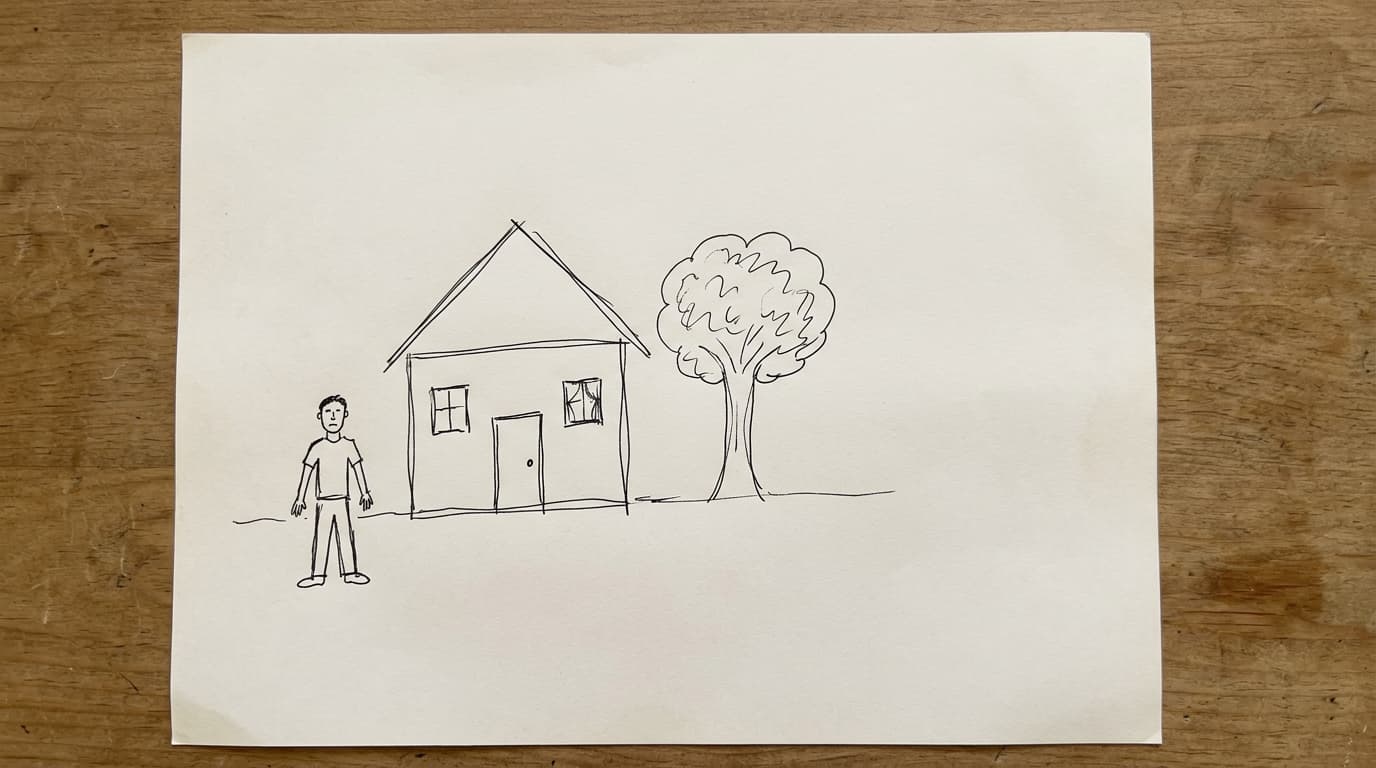
Example drawing: House-Tree-Person (HTP)
Product-created example drawing. No real user's content is shown.

Quick Read

  • The drawing presents a highly structured, horizontal arrangement of the house, tree, and person, characterized by clean lines and distinct spacing between each element.
  • A clear size hierarchy is established, with the house drawn as the largest component, followed by the tree, and the person as the smallest figure.
  • The elements are grounded on a shared baseline, with moderate detail such as curtains in one window and fingers on the figure, while avoiding complex environmental shading.
  • The overall composition avoids overlapping elements, presenting a clear, sequential layout that invites self-reflection rather than supporting direct diagnostic conclusions.

Observation before interpretation

What We Observed

  • The drawing is horizontally arranged across the middle of the page, leaving substantial whitespace at the top and bottom.
  • The three elements (person, house, tree) are placed side-by-side with clear spacing between them, avoiding any overlap.
  • The house is the largest element, followed by the tree, and then the person, who is the smallest.
  • The house is a simple 2D structure with a triangular roof, a rectangular body, a single door, and two windows (one with curtains).
  • The tree is a deciduous type with a trunk that flares at the base and a rounded, cloud-like crown containing internal curved lines.
  • The person is a fully drawn male figure standing on the left, facing forward, with visible facial features, arms, legs, and simple clothing.
  • The drawing uses clean, simple lines with moderate detail (curtains in one window, fingers on the hands, hair on the person, internal lines in the tree crown) but lacks complex shading or environmental context like paths or clouds.

Drawing overview

The drawing is executed with clean, dark ink on a white landscape-oriented sheet of paper, positioned centrally along the horizontal axis but leaving substantial whitespace at the top and bottom. This spatial arrangement highlights the three core elements in a clear, sequential manner, allowing each to be viewed independently without visual crowding.

The line quality is steady and deliberate, showing no signs of heavy sketching, hesitation, or correction. This clean execution presents a legible composition where each form is clearly defined, reflecting a structured approach to the drawing task.

The three primary elements—the house, the tree, and the person—are arranged from left to right across the page. This horizontal layout establishes a clear narrative flow, grounding each element on a shared plane and inviting a systematic exploration of their relationships.

House: overall structure

The house occupies the central portion of the page, serving as the largest and most prominent element in the drawing. This central placement and substantial scale draw immediate attention, establishing the house as a focal point of the composition.

The roof is drawn as a simple, symmetrical triangle that overlaps slightly at the apex, resting on a solid rectangular base. This classic, two-dimensional representation of a house structure is clean and balanced, showing a clear understanding of basic geometric forms.

The house is drawn from a direct, frontal perspective, resting firmly on a horizontal baseline that anchors it to the ground. This perspective avoids complex three-dimensional angles, presenting a straightforward and stable depiction of the home environment.

House: access and environment

The house features a single rectangular door with a small doorknob, flanked by two square windows, each divided into four panes. This symmetrical arrangement of access points and openings provides a balanced facade, suggesting a structured and accessible interior.

The right window contains visible curtains drawn to the sides, adding a layer of domestic detail that is absent from the left window. This specific detail introduces a touch of personalization and warmth, contrasting with the simpler lines of the rest of the house.

There are no chimneys, pathways, fences, or surrounding vegetation, leaving the house's immediate environment open and uncluttered. The absence of these common additions keeps the focus entirely on the primary structure, avoiding complex environmental context.

Tree: growth structure

Located to the right of the house, the tree is slightly smaller than the house but significantly larger than the person. This scaling positions the tree as a substantial natural element within the scene, balancing the house on the right side of the page.

The trunk is straight and vertical, flaring outward at the base to meet the horizontal baseline. This flaring suggests a stable connection to the ground, representing a healthy and grounded growth structure without exaggerated root systems.

The crown is rounded and symmetrical, balancing the composition on the right side of the page. This simple, balanced structure avoids complex or asymmetrical growth patterns, presenting a clear and recognizable depiction of a deciduous tree.

Tree: branches and surface detail

The crown is defined by a continuous, cloud-like scalloped line, with several internal curved lines suggesting foliage depth. This moderate level of detail provides a sense of texture and volume without overwhelming the drawing with individual leaves.

No individual branches are drawn extending from the trunk, and the trunk surface is left completely blank without bark texture or scars. This lack of surface detail keeps the trunk simple and clean, focusing attention on the overall shape of the tree.

There are no fruits, leaves, cavities, or fallen elements, maintaining a clean and simplified representation of a deciduous tree. The absence of these details avoids complex symbolic interpretations, keeping the focus on the tree's basic form.

Person: whole figure

A single male figure is positioned on the far left of the composition, standing upright and facing forward. This placement separates the person from the other elements, establishing a distinct presence on the left side of the page.

The figure is drawn in a rigid, frontal posture with arms hanging straight down at the sides, slightly away from the body. This formal, symmetrical stance is common in drawing tests and presents a clear, unobstructed view of the entire figure.

The person is the smallest of the three elements, grounded on a baseline that extends to the left edge of the page. This relative size hierarchy positions the person as a modest participant in the scene, dwarfed by both the house and the tree.

Person: body and expression detail

The head is oval-shaped with short hair, simple eyes, a nose, and a small, straight mouth that conveys a neutral expression. This simple facial representation avoids strong emotional cues, presenting a calm and neutral demeanor.

The figure wears a simple short-sleeved t-shirt and long pants, with hands showing individual fingers and feet pointing outward. The inclusion of fingers and basic clothing details shows a moderate level of detail, indicating a complete and careful representation of the human form.

No additional objects, pockets, or complex clothing details are present, keeping the figure's representation basic and clear. This simplicity avoids distracting elements, focusing entirely on the essential structure of the person.

House, tree, and person relationships

The house and tree are placed side-by-side with a clear gap between them, sharing a continuous baseline but not overlapping. This spatial separation allows each element to maintain its individual identity while contributing to a cohesive landscape.

The person stands to the left of the house, separated by a distinct space, with the house's height being roughly double that of the person. This spatial relationship emphasizes the house as a dominant, protective, or central structure in relation to the individual.

The tree and person are positioned on opposite sides of the house, creating a symmetrical framing effect with the house in the center. This balanced arrangement suggests a structured relationship where the home serves as a central anchor between nature and the individual.

Shared-space integration

All three elements are aligned along a single, horizontal baseline that runs across the lower-middle portion of the page. This shared baseline provides a strong sense of grounding and stability, connecting the person, house, and tree within a unified environment.

The upper half of the page is entirely empty, creating a strong contrast between the grounded drawings and the open space above. This use of whitespace draws focus downward to the horizontal sequence, emphasizing the grounded nature of the scene.

The horizontal arrangement and lack of overlapping elements create a highly structured, sequential, and non-overlapping scene. This clear spatial organization suggests a preference for order and clarity, presenting each element in its own dedicated space.

Integrated reflection

The deliberate separation and clear spacing of the house, tree, and person suggest a preference for order, clarity, and structured boundaries. This layout invites reflection on how one organizes their personal life, balancing different domains such as home, nature, and self without allowing them to overlap or conflict.

The inclusion of specific details like curtains in one window, contrasted with the lack of a pathway or chimney, highlights a selective focus on domestic comfort and privacy. This choice may invite self-reflection regarding which aspects of one's environment are prioritized for detail and attention.

The shared baseline and relative sizes (House > Tree > Person) present a balanced but hierarchical view of the self in relation to home and nature. This hierarchy invites the drawer to consider their perceived scale and presence within their broader life context.

The person's rigid stance and neutral facial expression offer a blank canvas for emotional projection, rather than indicating a specific psychological state. This neutrality serves as a valuable starting point for exploring personal feelings and attitudes in a non-diagnostic manner.

Reflection Questions

  1. What does the horizontal arrangement and clear spacing between the house, tree, and person represent to you in terms of your personal boundaries?
  2. How do you feel about the relative sizes of the elements, where the house is the largest and the person is the smallest?
  3. What led you to include curtains in only one of the windows, and what does that detail mean to you?
  4. The person in your drawing has a neutral expression and a rigid posture. What emotions or thoughts do you associate with this figure?
  5. How does the shared baseline connecting all three elements reflect your sense of grounding or stability in your current life?
  6. What other elements, such as a pathway, chimney, or clouds, did you choose to omit, and how does that affect the overall feeling of the scene?

Research and Methodology

Evidence strength: The overall evidence strength for individual diagnostic interpretation of HTP drawings is low to contradictory. While group-level associations exist in clinical research, individual features cannot be reliably mapped to specific personality traits or psychological diagnoses.

Limitations

  • Most method evidence is correlational, clinical, child-focused, culturally bounded, or based on group differences.
  • The same visible feature can arise from artistic preference, skill, materials, instructions, or momentary context.
  • Absence of generalizable evidence is not proof that a feature has no personal meaning to its creator.

Conflicting or null findings

  • Some historical studies suggest correlations between drawing features and personality traits, whereas modern systematic reviews and critical meta-analyses find insufficient evidence to support individual diagnostic validity.

Sources

  1. Analysis of the screening and predicting characteristics of the house-tree-person drawing test for mental disorders: A systematic review and meta-analysis2023DOI
  2. Association of Synthetic House-Tree-Person Drawing Test and Depression in Cancer Patients2019DOI
  3. House-Tree-Person Drawings and Personality Traits1972DOI
  4. The Scientific Status of Projective Techniques2000DOI