Sample Report - Example Only
Family Drawing
This example shows the structure and evidence limits of a complete InnerCanvas report. It is not an assessment of the viewer.

Quick Read
- The drawing depicts four human figures arranged in a neat, linear sequence, standing close to one another but maintaining distinct physical boundaries without overlapping or physical contact.
- Each figure is highly individualized through detailed clothing, distinct colors, and facial features, reflecting a high level of complexity and care in the drawing process.
- The formal features of the drawing, such as the static frontal postures and the shared baseline, provide a structured framework for self-reflection rather than serving as direct evidence of psychological traits or clinical diagnoses.
Observation before interpretation
What We Observed
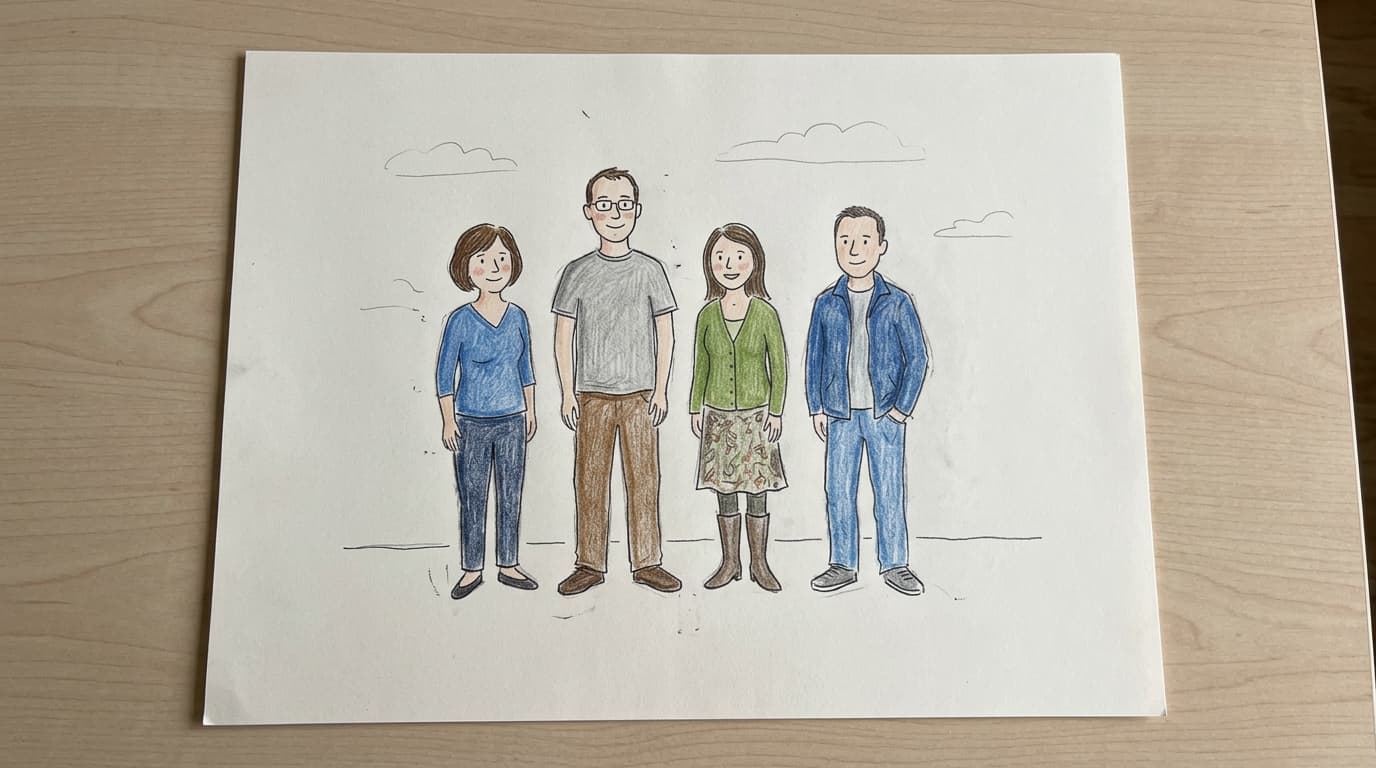
- Four human figures are depicted standing side-by-side in a horizontal row.
- The figures are positioned centrally on the horizontal page, leaving substantial white space at the top and bottom margins.
- The figures are arranged in a linear sequence with small, relatively uniform gaps between them, standing close but without physical contact or overlapping.
- The figures vary slightly in height, with the second figure from the left being the tallest, followed by the fourth figure, while the first and third figures are slightly shorter.
- The outlines of the figures, baseline, and clouds are drawn with clean, continuous, and well-defined black ink lines.
- The drawing features a high level of detail, including distinct clothing styles (V-neck shirt, cardigan, patterned skirt, boots, jacket with hand in pocket), facial features (eyes, noses, smiles, glasses), colored pencil shading, and background elements (three clouds and a single horizontal baseline).
- All four figures are standing in a static, frontal posture, facing the viewer with smiles, and no physical contact or active kinetic interaction is shown.
Family-scene overview
The drawing presents a structured and balanced composition featuring four human figures standing side-by-side in a horizontal row. The figures are positioned centrally on the page, utilizing the middle horizontal band and leaving substantial, symmetrical white space at both the top and bottom margins. This centered placement suggests a deliberate and organized approach to the drawing task, establishing a clear visual focus on the family group.
The environment is minimalist but clearly defined, consisting of a single horizontal baseline that anchors all four figures and three simple clouds drawn in the upper portion of the page. The overall layout is open and uncluttered, which emphasizes the figures themselves and their spatial relationships. This structured arrangement provides a neutral, clear canvas for exploring how the creator conceptualizes the family unit.
Member-by-member inventory
Starting from the far left, the first figure (Figure 1) is a female presentation with short brown hair, wearing a blue long-sleeved V-neck shirt, dark blue pants, and black shoes. She stands in a straight, frontal posture with her arms resting at her sides, facing the viewer with a gentle smile. The clean outlines and careful coloring of this figure establish a high level of detail from the outset of the drawing.
The second figure from the left (Figure 2) is a male presentation wearing glasses, a grey t-shirt, brown pants, and brown shoes. He is the tallest figure in the drawing and stands in a similar frontal posture with his arms at his sides and a smile on his face. The inclusion of specific details like glasses and the distinct color palette of his clothing highlights a clear effort to individualize this member of the group.
The third figure from the left (Figure 3) is a female presentation with medium-length brown hair, wearing a green cardigan over a lighter top, a patterned skirt, and brown boots. She stands straight, facing forward with a smile, and is slightly shorter than the figures flanking her. The intricate pattern on her skirt and the depiction of boots add a unique layer of complexity to her representation, distinguishing her from the other figures.
The fourth figure on the far right (Figure 4) is a male presentation with short brown hair, wearing a blue jacket over a grey shirt, blue jeans, and grey shoes. Unlike the other figures, he stands with his left hand placed in his jacket pocket, introducing a slight variation in posture while maintaining the overall frontal, smiling presentation. This subtle postural detail adds a touch of casual realism to his individual depiction.
Self or focal figure
Because the creator's identity has not been confirmed through user input, it is not possible to definitively identify which figure represents the self or serves as the primary focal point of the drawing. In family drawings, identifying the self-figure is a critical step that must rely entirely on the creator's direct confirmation rather than external assumptions. Attempting to infer the self-figure based solely on visual cues like height or placement is unreliable and scientifically unsupported.
While Figure 2 is the tallest and occupies a central position, and Figure 4 features a unique posture with a hand in his pocket, these formal variations do not automatically designate them as focal figures or represent stable psychological traits. Instead, these features serve as neutral starting points for the creator to reflect on which figure they identify with most and how they perceive their own role and presence within this family scene.
Grouping and distance
The figures are arranged in a linear, side-by-side sequence with small, relatively uniform gaps separating them. There is no overlapping, physical contact, or clustering of specific figures, which creates a sense of structured order and equal spacing across the group. This formal arrangement highlights a balance between connection and individual boundaries, as the figures stand close together but remain physically distinct.
The use of a single, continuous baseline further unifies the group, anchoring all four figures to the same ground and suggesting a shared context or environment. The combination of a shared baseline and consistent spacing invites the creator to reflect on the balance between individuality and togetherness in their family, exploring whether this structured distance feels comfortable, protective, or representative of their daily interactions.
Scale and visual hierarchy
There are visible variations in height among the four figures, with Figure 2 being the tallest, followed by Figure 4, Figure 1, and Figure 3. In family drawing analysis, relative size is sometimes hypothesized to reflect perceived importance or dominance, but empirical research shows that these variations are highly context-dependent and often simply reflect physical reality, artistic skill, or spontaneous drawing choices. Therefore, no direct psychological hierarchy can be inferred from these height differences alone.
A balanced visual hierarchy is maintained through the consistent level of detail, line quality, and coloring applied to all four figures. No single figure is drawn with significantly more complexity or care than the others, suggesting a relatively equal distribution of visual attention and importance across the entire group. This formal balance provides a neutral starting point for the creator to discuss how they perceive the distribution of influence or presence within the family.
Roles and individualization
The drawing exhibits a high degree of individualization, with each figure wearing distinct clothing styles and colors. Figure 1 wears a simple blue V-neck and pants, Figure 2 wears a grey t-shirt and glasses, Figure 3 wears a green cardigan and a patterned skirt with boots, and Figure 4 wears a blue jacket and jeans. These specific choices in attire and accessories distinguish each figure as a unique individual, reflecting a thoughtful representation of personal identity.
Despite this high level of individualization in appearance, the figures are depicted in static, frontal postures without active kinetic roles or tasks. They are not shown interacting with objects or performing specific family duties, which keeps their roles in the scene neutral and open. This contrast between detailed individual appearance and static posture invites reflection on how family members express their individuality while maintaining a shared, cohesive group identity.
Inclusion and non-depiction
The drawing includes exactly four human figures, presenting a complete and self-contained group within the centered composition. From a formal standpoint, we can only record who is visibly present in the drawing; we cannot infer whether any family members, pets, or significant others have been excluded or left out. Such inferences are speculative and lack scientific validity without direct context from the creator.
The inclusion of these four specific figures, standing together on a shared baseline, serves as a neutral representation of the family scope as defined by the creator for this drawing. This visual boundary invites a reflective inquiry into who is represented in this space, what these four individuals mean to the creator, and whether there are other family members or aspects of their family life that they might choose to depict in a different context.
Shared environment and boundaries
The figures are depicted in an outdoor setting, indicated by a single horizontal baseline representing the ground and three simple clouds drawn in the sky above. There are no indoor elements, such as walls, furniture, or rooms, and no physical barriers separating the figures from one another. This open, shared environment suggests a common space where all members coexist without physical division.
The lack of physical boundaries or structures between the figures, combined with their linear arrangement, emphasizes an open and accessible shared space. However, the distinct spacing between each figure maintains clear individual boundaries. This formal layout invites the creator to reflect on how physical and emotional space is shared in their family, and whether they prefer open, shared environments or more structured, private spaces.
Visible relationship map
The visible relationship map in this drawing is characterized by proximity, linear alignment, and a shared frontal orientation. The figures stand side-by-side, all facing forward toward the viewer, with no physical contact, overlapping, or direct eye contact between them. This parallel arrangement presents a structured, orderly relationship pattern where each member occupies a distinct, equal space in the line.
Because the figures are standing still and facing forward rather than interacting with one another, the drawing does not depict active kinetic relationships or emotional dynamics. This static presentation is a formal feature that should be explored through self-reflection rather than diagnostic interpretation, allowing the creator to describe the nature of the connections, communication, and emotional bonds that exist behind this structured, smiling facade.
Integrated reflection
Synthesizing the formal features of the drawing—such as the clean ink outlines, detailed and colorful clothing, structured linear arrangement, and static frontal postures—reveals a highly organized and thoughtful representation of a four-member group. These visual patterns are not direct evidence of stable psychological traits or family dynamics, but they serve as rich, personalized starting points for the creator to reflect on their family experience.
Research emphasizes that drawing features are highly context-dependent and influenced by artistic skill, materials, and momentary preferences, meaning no reliable individual psychological inference can be made from this drawing alone. Instead, the creator is encouraged to use these observations as a starting point for personal inquiry, exploring how the structured order, individual details, and shared space of the drawing align with their own feelings and perceptions of their family life.
Reflection Questions
- What thoughts or feelings guided your choice of clothing and colors for each of the four figures?
- How does the structured, side-by-side arrangement of the figures reflect the way you experience connection and personal space in your family?
- If you were to add an active, shared task or movement to this drawing, what would the figures be doing together?
- Who do you identify as the self-figure in this drawing, and how does their position and height feel to you?
- What does the open, outdoor environment with the clouds and baseline represent for you compared to an indoor setting?
- Are there any other family members, pets, or elements you thought about including but decided to leave out?
Research and Methodology
Evidence strength: The scientific evidence supporting the interpretation of family drawings is limited and highly context-dependent. While formal features can be described neutrally to facilitate self-reflection, empirical research does not support using single drawing features to make stable psychological diagnoses, trait inferences, or clinical assessments.
Limitations
- Most family drawing research is based on child populations and group-level correlations, which cannot be directly or reliably applied to individual adult drawings.
- Scoring reliability in research studies does not equate to interpretive validity for individual assessment.
- Drawing features are heavily influenced by non-psychological factors such as artistic experience, drawing materials, instructions, and the immediate context of administration.
Conflicting or null findings
- Some clinical literature suggests specific meanings for relative size and spacing, whereas comprehensive scientific reviews indicate that these features do not reliably predict individual psychological traits or family dynamics.