Sample Report - Example Only
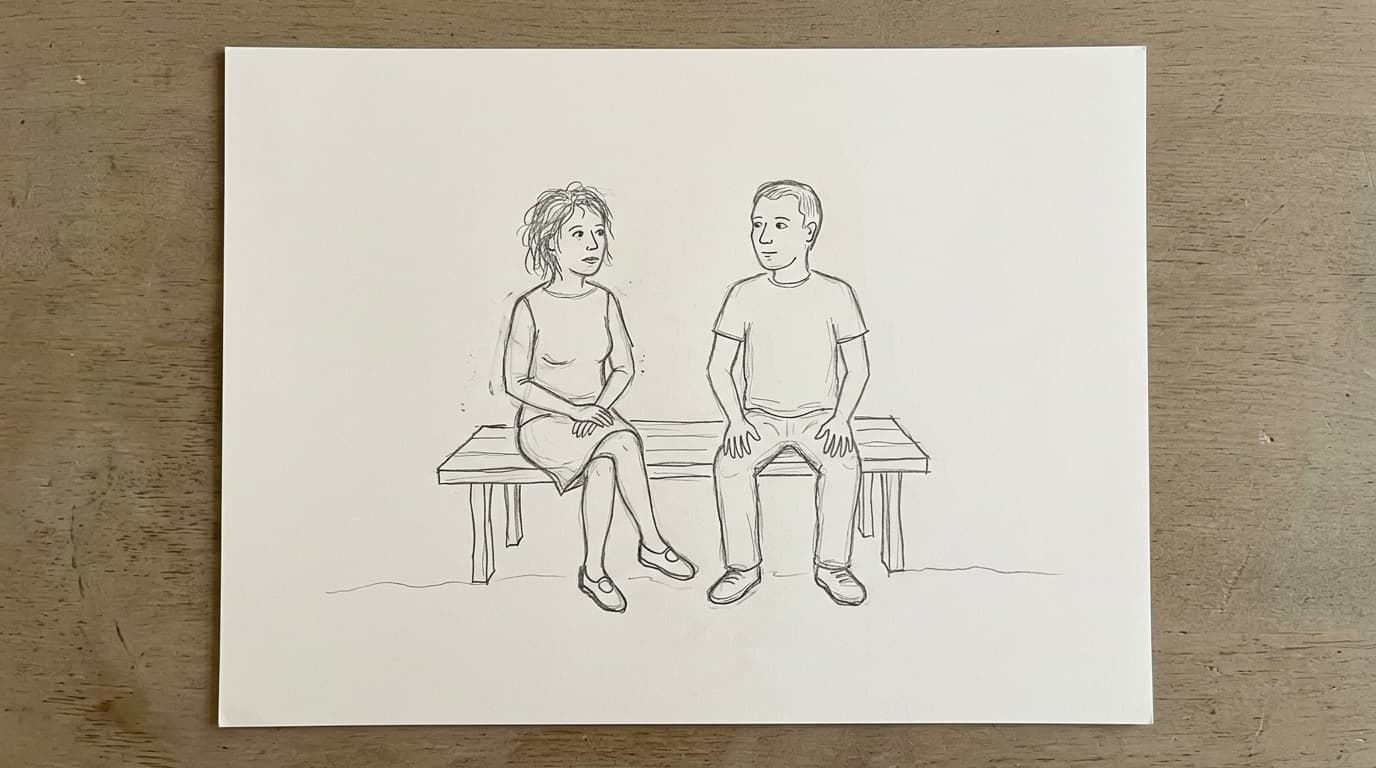
Couple Drawing
This example shows the structure and evidence limits of a complete InnerCanvas report. It is not an assessment of the viewer.

Quick Read
- The drawing features two human figures seated on a shared wooden bench, centered horizontally on the page with balanced margins. This composition establishes a clear, self-contained scene of mutual orientation and quiet co-presence, where both figures are positioned to face each other directly.
- Each figure is depicted with distinct individual characteristics, including unique hairstyles, clothing, and postures, while maintaining a highly similar vertical scale and level of detail. This balance ensures that neither figure dominates the visual space, presenting them as equal participants in the scene.
- While the figures share a common environment and are oriented toward one another, they are separated by a distinct physical gap on the bench and do not engage in active touch. This combination of proximity and distance serves as a neutral starting point for self-reflection regarding personal boundaries and connection, rather than a diagnostic indicator of relationship quality.
Observation before interpretation
What We Observed
- Two human figures are drawn on the page, positioned side-by-side on a bench.
- The drawing is centered horizontally on the page, utilizing the middle portion of the sheet with ample white space around it.
- The two figures are oriented towards each other, with their heads and torsos turned slightly inward, and their gazes directed toward one another.
- The figures are seated on the same bench but are separated by a visible physical gap, with no overlapping lines or physical contact.
- The two figures are drawn with similar vertical scale and level of detail, with neither figure dominating the composition in size or visual weight.
- Both figures are seated on a single, shared wooden bench, which is supported by legs and rests on a single horizontal ground line.
- The figures are depicted in a passive, seated posture, engaged in mutual gaze without active physical touch or shared hand-held objects.
Two-person scene overview
The drawing presents a structured composition containing exactly two human figures positioned on a wooden bench, which is centered horizontally on the page. The deliberate placement of the figures and the bench in the middle of the sheet leaves substantial white space on all sides, creating a focused and self-contained visual field. This balanced use of the page draws immediate attention to the interaction between the two characters, establishing a clear and intentional scene of co-presence.
The overall setting is minimalist, defined primarily by the bench and a single horizontal ground line that provides a stable baseline for the entire composition. The figures are depicted in a passive, seated posture, oriented slightly inward toward one another. This formal arrangement establishes a shared context and a clear visual relationship between the two individuals, serving as a neutral starting point for exploring how space and positioning are represented.
Person A
The figure on the left, designated as Person A, is depicted with curly, shoulder-length hair and is dressed in a long-sleeved top and a skirt. Her posture is characterized by crossed legs, with her right leg resting over her left, and her hands are clasped together in her lap. This specific arrangement of limbs and clothing gives her a distinct, self-contained physical presence within the drawing.
Person A's body and head are turned slightly toward the right, and her facial features, including her eyes, nose, and mouth, are clearly rendered and directed toward the other figure. This orientation establishes a clear line of sight and suggests an attitude of quiet attentiveness. While these details are highly specific, they represent a momentary artistic choice rather than a stable psychological trait, serving as a starting point for personal reflection.
Person B
The figure on the right, designated as Person B, is depicted with short hair and is dressed in a short-sleeved t-shirt and long pants. His posture is stable and symmetrical, with his legs slightly apart and both feet resting flat on the ground. His hands are placed flat on his thighs, creating a grounded and open physical stance that contrasts with the crossed posture of Person A.
Person B's body and head are oriented slightly toward the left, with his gaze directed toward Person A. His facial features are clearly visible, mirroring the mutual attention observed in the other figure. This independent representation highlights his distinct role in the scene, emphasizing that he is drawn as a complete individual rather than an accessory to the other figure.
Scale and individualization
The two figures are drawn with a highly similar vertical scale and level of detail, ensuring a balanced visual weight across the composition. Neither figure is depicted as significantly larger, more detailed, or more dominant than the other, which suggests an artistic representation of equality and mutual importance within the shared space.
Despite their shared scale, each figure is highly individualized through distinct clothing, hairstyles, and postures. This combination of balanced scale and individual detail highlights the separate identities of the two characters, showing that they are represented as distinct individuals. Research on relative size and individualization in drawings is context-dependent, and no reliable individual inference can be made from these features alone.
Distance, orientation, and sightline
The figures are seated on the same bench but are separated by a visible physical gap, with no overlapping lines or physical contact between them. Their bodies and heads are turned toward each other, creating a direct line of sight and a clear sense of mutual orientation. This spatial arrangement combines elements of connection (mutual gaze) and separation (physical distance).
This specific combination of distance and orientation is a formal feature that can invite different personal meanings. While some might view the gap as a representation of personal boundaries, others might see the mutual gaze as a sign of strong connection. The evidence does not support a reliable psychological inference here, and this arrangement should be used as a starting point for self-reflection rather than a diagnostic conclusion.
Contact, action, and reciprocity
The drawing depicts the figures in a passive, seated posture with no active physical touch, hand-holding, or shared hand-held objects. Their interaction is entirely non-verbal and visual, characterized by their mutual gaze and inward-facing postures. This lack of physical contact highlights a state of quiet co-presence rather than active physical engagement.
The absence of active touch or physical reciprocity is a formal feature that can be interpreted in multiple ways depending on the creator's personal context and artistic style. It may represent a comfortable, respectful distance or a moment of quiet contemplation. Because drawing-based measures of interaction are highly context-dependent, this feature is a starting point for reflection rather than a trait conclusion.
Shared objects and environment
The primary shared element in the drawing is the wooden bench, which physically connects the two figures within the same space. The bench is supported by visible legs and rests on a single horizontal ground line, providing a stable and structured environment for the characters. This shared object defines a clear, common territory for their interaction.
The bench and the ground line establish a secure, shared context while preserving individual personal space. The open space between the figures on the bench allows for a clear boundary between their personal areas. This structured environment serves as a neutral visual framework, and the evidence does not support a reliable psychological inference regarding relationship quality from these environmental features alone.
Two-person narrative
The drawing depicts a specific, quiet moment of mutual observation on a bench, suggesting a narrative of shared presence or silent communication. The sequence of events is open-ended, leaving it unclear whether the figures have just sat down, are in the middle of a conversation, or are simply enjoying a quiet moment together. This ambiguity allows the viewer or creator to project their own narrative onto the scene.
From the visual evidence, both figures appear to share the goal of mutual attention, as indicated by their direct gazes and inward-facing postures. However, their individual viewpoints are distinguished by their different postures and physical stances. This narrative structure is a starting point for reflection, allowing the creator to consider what this choice meant to them while drawing.
Integrated reflection
When considered together, the formal features of the drawing—including the mutual orientation, the balanced scale, the shared bench, and the physical gap—create a complex and nuanced visual dialogue. Rather than inferring relationship quality from a single feature, these dimensions must be viewed as an integrated whole that reflects a balance between connection and individual boundaries.
This drawing serves as a rich tool for self-reflection, inviting the creator to explore their own feelings about closeness, distance, and individuality. The visual evidence does not support a reliable psychological inference or diagnostic conclusion, but it offers a safe space to contemplate personal dynamics and artistic choices. One may consider how these visual elements align with their own experiences of connection.
Reflection Questions
- What does the physical distance between the two figures on the bench represent to you?
- How do you interpret the mutual gaze and inward orientation of the characters?
- What feelings or thoughts arise when you observe the contrast between Person A's crossed posture and Person B's open posture?
- If the figures on the bench were to start speaking, what do you imagine they would say to each other?
- How does the minimalist setting, with only the bench and a ground line, influence your perception of their relationship?
- In what ways does the balanced scale of the two figures reflect your own views on equality and individuality in connections?
Research and Methodology
Evidence strength: Limited and context-dependent, with significant methodological boundaries in transferring group-level findings to individual drawings.
Limitations
- Most drawing-based research is correlational and cannot establish causal links or stable psychological traits.
- The observed interaction during a joint-drawing session differs significantly from an individual's finished drawing of a couple.
- Artistic experience, cultural background, and administration instructions heavily influence the formal features of a drawing, limiting the validity of standardized interpretations.
Conflicting or null findings
- While some studies suggest group-level associations between drawing features and relationship perceptions, critical reviews emphasize that these features do not reliably predict individual psychological traits or attachment classifications.