Sample Report - Example Only
Bridge Drawing
This example shows the structure and evidence limits of a complete InnerCanvas report. It is not an assessment of the viewer.

Quick Read
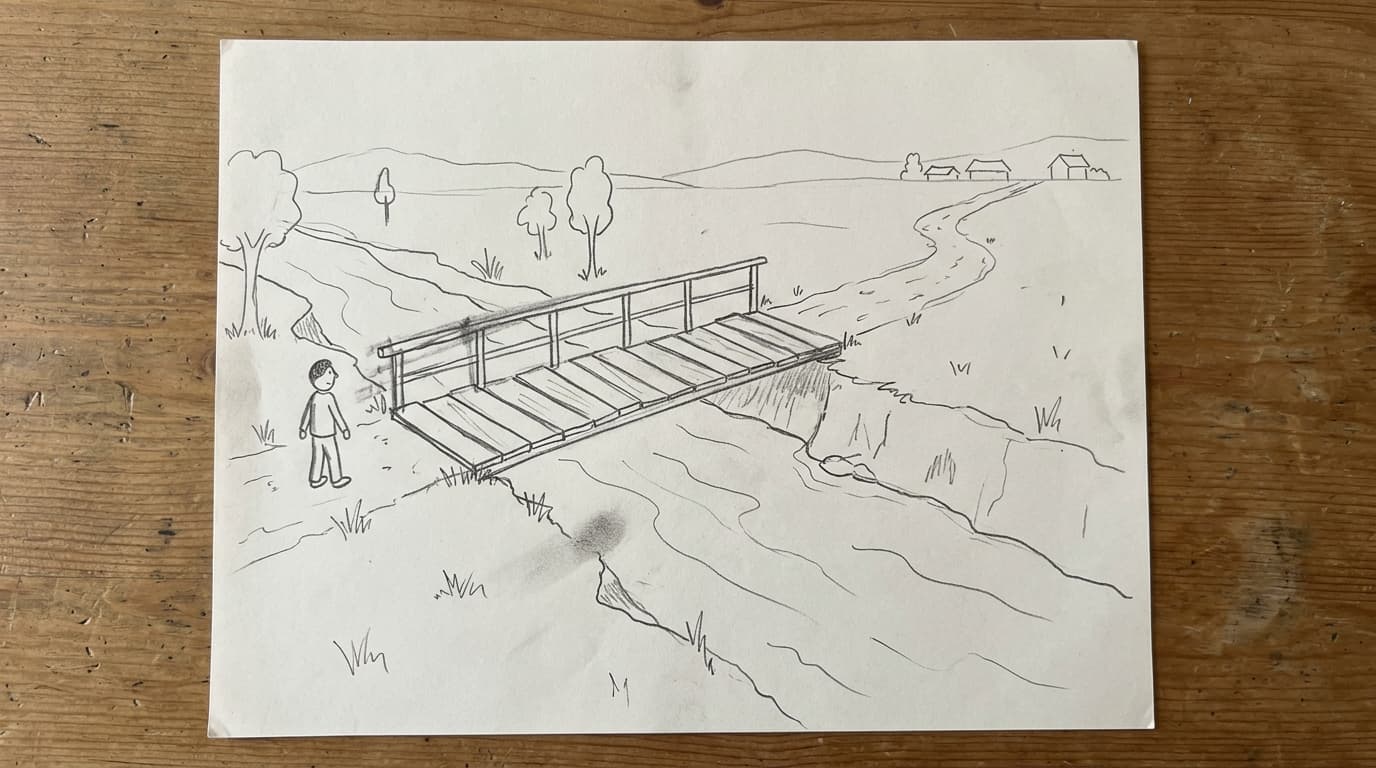
- The drawing depicts a complete transition scene where a person stands on the left bank, facing a fully visible bridge that spans a river toward a winding path and distant houses.
- The structural clarity of the bridge and the continuous lines suggest a stable pathway, though individual artistic style and context heavily influence these formal choices.
- While the drawing provides a rich visual narrative of transition, scientific evidence cautions against using single drawing features to infer stable psychological traits or clinical diagnoses.
Observation before interpretation
What We Observed
- The drawing utilizes the entire page, with a clear foreground (left bank with person), midground (bridge spanning the river), and background (hills and houses on the right).
- The bridge is fully visible, spanning from the left bank to the right bank over a river. It is constructed of parallel wooden planks and has a single handrail on its upper side.
- The bridge is oriented from the left-middle foreground towards the right-middle background, creating a diagonal path across the river.
- A small, simplified human figure is standing on the left bank, positioned at the entrance of the bridge, facing towards the bridge and the right side of the page.
- The endpoints of the bridge are clearly defined: the left side (origin) features a path, a tree, and grass; the right side (destination) features a winding path leading to three small houses and hills in the far background.
- The lines are clean, continuous, and drawn with a fine-tip pen or pencil, with some soft pencil shading under the bridge and on the path near the person.
- The drawing contains moderate to high detail, including individual planks on the bridge, grass tufts, river currents, multiple trees, a winding path, and distant houses.
Transition-scene overview
The drawing presents a comprehensive transition scene utilizing the entire page, where a small human figure stands on the left bank of a river, looking toward a fully visible bridge that spans across to the right bank. This layout establishes a clear spatial relationship between a starting point, a crossing mechanism, and a distant destination.
The bridge is oriented diagonally from the left-middle foreground to the right-middle background, creating a strong visual flow that guides the viewer's eye across the water. This directional movement is further extended by a winding path on the right bank that leads toward a cluster of small houses in the distance.
The surrounding environment is rendered with moderate detail, including trees, grass tufts, and distant hills, which frame the transition scene. While these elements create a peaceful rural context, research cautions that environmental details are highly dependent on artistic preference and situational factors rather than universal psychological meanings.
Origin area
The origin area on the left bank serves as the starting point of the depicted journey, featuring a prominent tree, grass tufts, and a path where the human figure is positioned. This area is clearly defined and provides a stable ground for the figure before the bridge crossing.
Visual details in the origin area, such as the soft pencil shading near the path and the figure's feet, add a sense of depth and texture to the starting ground. However, the presence or absence of such shading is heavily influenced by the drawing medium and the creator's artistic experience, limiting its use as a direct measure of psychological traits.
The edge of the left bank forms a distinct vertical boundary that drops down to the river, separating the starting ground from the water. While some historical interpretations might view this boundary as a symbol of security or hesitation, scientific evidence is insufficient to support any stable psychological diagnosis or emotional state from this feature alone.
Destination area
The destination area on the right bank is characterized by a winding path that leads toward three small houses situated against a backdrop of rolling hills. This area represents the endpoint of the transition, providing a clear visual goal for the journey depicted in the drawing.
The destination is fully visible and appears accessible, with the winding path suggesting a gradual approach to the houses. The smaller scale of the houses and hills emphasizes their distance from the starting point, creating a sense of future orientation that can be explored through self-reflection.
The houses and hills are drawn with simple, clean lines, maintaining a consistent level of detail with the rest of the landscape. Although the clarity of the destination is a prominent feature, research emphasizes that individual interpretations of what these houses represent are highly subjective and cannot be universally standardized.
Bridge structure
The bridge itself is a straight, horizontal structure constructed of individual wooden planks that span the entire width of the river. This solid construction provides a clear, physical connection between the origin and destination banks, serving as the central element of the transition.
A single handrail is visible on the far side of the bridge, supported by vertical posts, while the near side remains open. This asymmetrical design provides a balance of support and openness, which can serve as a neutral starting point for reflecting on one's perceived resources and safety during transitions.
The bridge is drawn with continuous, stable lines and shows no gaps, breaks, or steep slopes, indicating a secure and straightforward passage. While these structural qualities suggest stability, empirical evidence is insufficient to infer any specific psychological traits, such as resilience or anxiety, from the bridge's design.
Person position and posture
The human figure is positioned on the left bank, standing just before the entrance of the bridge and facing toward the right. This placement locates the person at the very beginning of the transition, poised to embark on the crossing but not yet on the bridge itself.
The figure is drawn in a simple, upright standing posture with basic limbs and facial features, appearing to look directly toward the bridge. This straightforward depiction can be used to invite self-reflection regarding the creator's readiness or feelings about an upcoming change.
The person is drawn at a small scale relative to the expansive landscape, with no additional objects, tools, or clothing details. While some might interpret this scale as a feeling of insignificance, scientific literature warns against drawing clinical conclusions about self-esteem or vulnerability from figure size alone.
Distance, route, and direction
The route of travel is clearly mapped out, starting from the left bank, crossing the level bridge, and continuing along a winding path on the right bank toward the distant houses. This continuous pathway establishes a clear direction of movement from left to right across the page.
The winding nature of the path on the destination side suggests a gradual, non-linear journey toward the final goal, rather than a direct or immediate arrival. This visual flow can invite reflection on how one perceives the timeline and steps involved in reaching personal objectives.
The entire route is visible and free of physical interruptions, blockages, or steep climbs, presenting a clear and navigable path. However, the ease of this route in the drawing cannot be used to predict real-world outcomes or assess an individual's actual coping capacity.
Obstacles, risks, and supports
The primary physical obstacle in the scene is the river flowing beneath the bridge, which features steep, defined banks on both sides. This water barrier represents a clear gap between the starting point and the destination, requiring a bridge to cross safely.
The bridge serves as the main support structure, offering a solid plank walkway and a single handrail to assist with the crossing. These features represent visible forms of support within the drawing, which can be used to explore the creator's thoughts on external resources.
The environmental conditions appear calm, with clean lines depicting a clear sky and no signs of adverse weather, other people, or immediate hazards. While the scene feels peaceful, research emphasizes that drawing a calm environment does not rule out internal distress or clinical anxiety.
Origin-bridge-destination integration
The drawing successfully integrates the origin, bridge, and destination into a cohesive, continuous landscape that tells a clear visual story. The spatial arrangement allows the viewer to trace the entire journey from the person's current position to the distant village.
The physical transition is fully realized, with the bridge securely connecting the left and right banks, and the path continuing seamlessly on the other side. This high level of integration can serve as a helpful visual metaphor for discussing how different phases of a transition connect.
The person's position at the threshold of the bridge highlights a specific moment of preparation, standing at the boundary of the familiar origin before stepping onto the crossing. While this placement is visually striking, it is important to avoid overinterpreting it as a sign of hesitation or fear without the creator's input.
Integrated reflection
Reflecting on the creator-defined endpoints, the clear starting bank and the distant village invite a discussion about current life circumstances and future aspirations. This visual contrast provides a structured way to explore what the destination represents to the individual.
The balance of potential obstacles, like the steep riverbank, and supports, like the sturdy bridge and handrail, invites a balanced consideration of challenges and resources. This reflection can help identify both internal strengths and external support systems in the creator's life.
With the person standing at the very entrance of the bridge, the drawing naturally focuses attention on the immediate next step of the journey. Exploring this moment of preparation can help the creator articulate their feelings about initiating a transition, free from clinical assumptions.
Reflection Questions
- What does the distant village represent to you, and how does it feel to look at it from the starting bank?
- The bridge has a handrail on one side but is open on the other. How does this balance of support and openness feel to you?
- The person is standing right at the entrance of the bridge. What thoughts or feelings might they have before taking the first step?
- The path on the other side is winding rather than straight. How do you relate to the idea of a gradual, non-linear journey?
- The riverbanks are steep and defined. What challenges or boundaries does the river represent in your current life transition?
- How does the presence of the trees and hills in the background contribute to your sense of safety or comfort in this scene?
Research and Methodology
Evidence strength: The evidence supporting the psychological interpretation of bridge drawings is limited and highly context-dependent. While historical art therapy literature suggests symbolic meanings for various features, modern quantitative reviews emphasize the lack of robust, generalizable empirical support for individual trait assessment. Consequently, formal features are best used as neutral starting points for self-reflection rather than diagnostic tools.
Limitations
- Most studies on projective drawings rely on small, culturally specific, or clinical samples, limiting generalizability to broader adult populations.
- Individual differences in artistic skill, experience, materials, and instructions can significantly influence drawing features, confounding psychological interpretations.
- There is a lack of standardized scoring systems with demonstrated high reliability and validity for individual assessment.
Conflicting or null findings
- Historical art therapy literature often attributes specific symbolic meanings to features like bridge material or handrails, whereas empirical reviews find no consistent correlation between these features and stable personality traits.
- Some clinical studies suggest associations between drawing details and emotional states, but large-scale meta-analyses indicate these associations are weak and unreliable for individual diagnosis.