Sample Report - Example Only
Bird's Nest Drawing
This example shows the structure and evidence limits of a complete InnerCanvas report. It is not an assessment of the viewer.

Quick Read
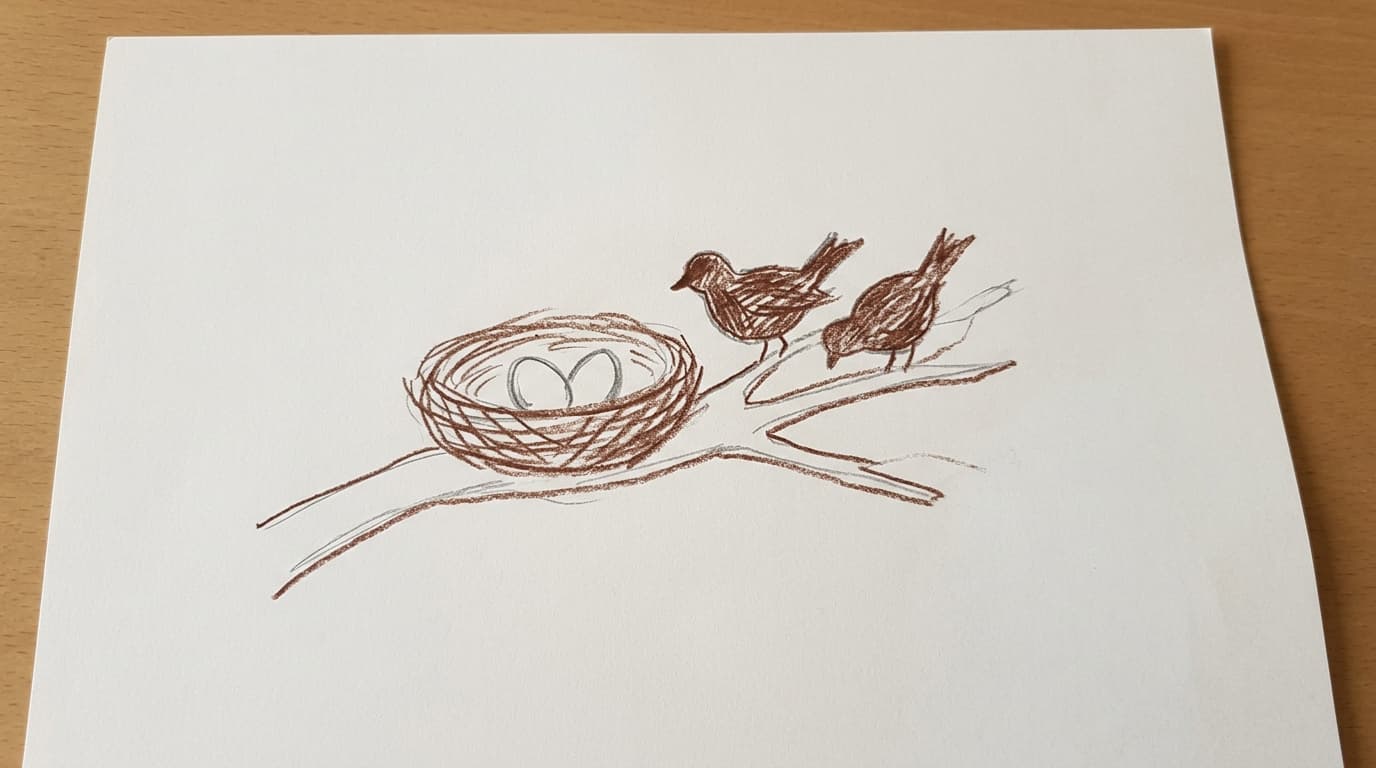
- The drawing features a centrally placed nest containing two eggs, supported by a branch, with two birds perched nearby, rendered in brown and grey pencils.
- The construction of the nest and birds utilizes sketchy, overlapping lines, while the eggs and branch are defined by simpler, more continuous outlines, reflecting a variation in line quality.
- There is a complete absence of external environmental details, such as leaves, sky, or ground, leaving the central elements isolated against the white paper.
- While these formal features can be described neutrally to invite self-reflection, they do not support direct psychological inferences regarding attachment security or trauma.
Observation before interpretation
What We Observed
- The drawing is rendered using brown colored pencil and grey graphite pencil on white paper.
- The drawing is centrally positioned on the page, leaving substantial white space around the main subjects.
- The drawing features moderate detail in the nest texture and bird feathers, but completely lacks background elements like leaves, sky, or ground.
- The nest and birds are drawn with sketchy, overlapping lines, while the eggs and branch are defined by more continuous, distinct outlines.
- The nest has a clearly defined, circular/oval boundary made of multiple woven brown lines, creating a distinct interior space.
- Two eggs, outlined in grey pencil, are clearly visible inside the nest.
- The nest is supported by a thick, double-lined branch that extends horizontally and splits into smaller twigs.
Nest-scene overview
The drawing presents a structured scene consisting of a nest, two eggs, a supporting branch, and two birds, all positioned in the central region of the page. The composition is balanced horizontally, with the nest on the left and the two birds perched on the right side of the same branch. This layout creates a clear spatial relationship between the nest and the birds, suggesting a narrative of proximity and observation.
The choice of materials is limited to brown colored pencil and grey graphite pencil, which gives the entire scene a rustic, naturalistic, yet minimalist appearance. The absence of vibrant colors or complex background elements focuses the viewer's attention entirely on the central interaction between the birds, the nest, and the eggs. This simplicity may reflect artistic preference, the availability of drawing tools, or a deliberate choice to emphasize the core subjects.
From a methodological standpoint, the overall layout and choice of elements should not be interpreted as a direct representation of the creator's internal psychological state or attachment style. Instead, the scene serves as a neutral visual starting point, where the spatial arrangement of the nest, birds, and branch can be explored through open-ended reflection rather than standardized diagnostic criteria.
Nest form and construction
The nest is constructed using multiple overlapping, sketchy brown lines that wrap around to form a circular or oval shape. This technique gives the nest a textured, woven appearance, mimicking the natural materials like twigs and grass that birds use in the wild. The density of the lines varies, creating a sense of depth and volume in the nest's structure.
The scale of the nest is moderate in comparison to the birds and the branch, appearing large enough to comfortably hold the two eggs inside. The completeness of the nest's boundary suggests a fully formed structure, though the sketchy nature of the lines leaves small gaps between the strokes. These formal qualities might be influenced by the creator's drawing style, fine motor control, or familiarity with sketching techniques rather than a specific psychological trait.
While some historical projective theories attempted to link nest construction details to specific personality traits, contemporary research emphasizes that such features are highly dependent on context and artistic experience. Therefore, the textured construction of this nest is best viewed as a creative choice, and any interpretation should remain tentative and creator-led.
Boundary, opening, and accessibility
The nest features a clearly visible top opening, which is oriented upwards and slightly tilted toward the viewer, allowing a full view of the interior space and the eggs within. The boundary of the nest is defined by a thick band of woven brown lines, creating a distinct barrier between the inside and outside environments. This boundary is continuous around the circumference, establishing a clear sense of enclosure.
Despite the solid boundary, the open top makes the interior highly accessible visually, with no cover, leaves, or canopy obscuring the view. The sketchy lines forming the boundary also introduce a degree of permeability, as they are not a solid block of color but rather a collection of individual strokes. This combination of a clear boundary and an open top presents a balance between containment and exposure.
In clinical and research contexts, the openness or closedness of a drawn nest has sometimes been discussed in relation to feelings of safety or vulnerability. However, empirical evidence shows that these visual features do not reliably predict an individual's psychological state or trauma history, and should instead be used as a starting point for personal reflection on how the creator perceives boundaries and accessibility.
Interior space and contents
Inside the nest, two eggs are clearly visible, drawn with simple, continuous grey pencil outlines. The eggs are positioned side-by-side in the center of the nest's interior, occupying a significant portion of the inner space. The use of grey pencil for the eggs contrasts with the brown colored pencil used for the nest, drawing visual attention to the contents.
The interior space of the nest appears relatively clean and organized, with no additional lining, debris, or other contents depicted. The eggs rest directly within the outlined inner bowl of the nest, and there are no young birds or adult birds inside the nest itself. This arrangement leaves the nest's interior quiet and expectant, focusing the narrative on the potential for life represented by the eggs.
The presence and number of eggs or birds in a drawing have been subject to various symbolic interpretations in projective testing, but scientific reviews caution against drawing firm conclusions from these elements. The depiction of two eggs is a common thematic choice that may simply reflect a standard mental representation of a bird's nest, rather than any specific family dynamic or attachment classification.
Support and holding structure
The nest is positioned directly on top of a thick branch that extends horizontally across the lower-middle portion of the page. The branch is drawn with a combination of brown and grey lines, showing a double-line structure that gives it a sense of thickness and stability. The nest sits securely in a fork or a flat section of the branch, indicating a stable support system.
The branch itself splits into smaller twigs on the right side, where the two birds are perched. The left side of the branch extends off the page, suggesting a connection to a larger, unseen tree trunk or structure. This visual link to an external, implied support system adds to the overall impression of stability and grounding for both the nest and the birds.
While the representation of a strong, supportive branch can be described as a stabilizing element in the composition, it is important to avoid translating this visual stability into a psychological diagnosis of resilience or security. The depiction of support structures is highly influenced by artistic conventions and the specific instructions given during the drawing task, and does not provide a reliable measure of an individual's support systems in real life.
Birds: number, position, and action
Two birds are depicted in the drawing, both perched on the branch to the right of the nest. They are rendered in brown colored pencil with sketchy, textured lines that suggest feathers. Both birds are positioned outside the nest, standing on the upper surface of the branch, and are oriented towards the left, looking in the general direction of the nest and the eggs.
The bird closer to the nest is standing upright, while the bird further to the right is leaning slightly forward, with its beak pointing downwards towards the branch. This variation in posture adds a dynamic quality to the scene, suggesting active behavior such as resting, watching, or foraging. The spacing between the two birds is close, indicating a pair-like relationship, but they remain physically separate from each other and from the nest.
The placement of the birds outside the nest, rather than inside tending to the eggs, is a formal feature that can invite diverse reflections on themes of caregiving, independence, or anticipation. However, research indicates that the positioning and actions of birds in these drawings cannot be used to diagnose attachment security or trauma, as these choices are often guided by the creator's immediate creative ideas or drawing skills.
External environment
The external environment in this drawing is characterized by a complete lack of background details. There are no indications of weather, sky, sun, clouds, ground, or other vegetation such as leaves or flowers. The branch, nest, eggs, and birds exist in an isolated space, surrounded entirely by the white background of the paper.
This minimalist approach focuses the entire composition on the primary subjects, removing any environmental context that might suggest a specific season, time of day, or level of threat. The absence of leaves on the branch further simplifies the scene, presenting a stark, clean environment where the branch is the sole physical element supporting the life depicted. This lack of detail may stem from a desire for simplicity, time constraints, or a focus on the core elements of the drawing instructions.
In projective drawing analysis, an empty background is sometimes hypothesized to represent isolation or a lack of environmental support, but scientific reviews emphasize that such interpretations lack empirical validity. The decision to omit background details is a common artistic choice and does not justify any clinical inferences about the creator's social support or emotional state.
Protection and openness as visual organization
The visual organization of the drawing presents a compelling interplay between protection and openness. The nest provides a clear, enclosed space for the eggs, defined by its thick, woven boundary, which suggests a protective environment. At the same time, the open top of the nest and the complete lack of surrounding foliage or cover expose the eggs to the open space, creating a sense of vulnerability.
This tension is further highlighted by the position of the birds, who are perched nearby on the branch rather than sitting on the nest to protect or warm the eggs. While the branch offers a stable and secure foundation for both the nest and the birds, the entire scene is open and visible, with no physical barriers protecting the nest from potential external elements. This balance of a strong support structure, a defined nest boundary, and an open, exposed environment forms the core visual structure of the drawing.
Rather than attempting to classify this visual organization into rigid categories of security or insecurity, it is more scientifically sound to view it as a complex creative composition. The coexistence of protective elements (the nest boundary and stable branch) and open elements (the exposed eggs and empty background) provides a rich visual metaphor that can be explored through personal reflection, without drawing any diagnostic conclusions.
Integrated reflection
The formal features of this drawing—such as the stable branch, the textured nest with two eggs, the two nearby birds, and the empty background—offer a rich canvas for self-reflection. By looking at the spatial relationships and the contrast between the detailed subjects and the blank space, the creator can explore their own personal associations with these images. This process of reflection is guided by the creator's own insights rather than external interpretation.
For instance, the proximity of the birds to the nest, combined with their position outside of it, might raise questions about the balance between connection and independence, or caregiving and self-reliance. The contrast between the sketchy, textured lines of the birds and nest and the clean outlines of the eggs and branch can also be a starting point for discussing different aspects of one's life or creative expression. These reflections are highly personal and context-dependent, varying greatly from person to person.
Ultimately, the value of the Bird's Nest Drawing lies not in its ability to reveal hidden psychological traits or trauma through standardized scoring, but in its capacity to serve as a creative mirror. By engaging with the drawing through open-ended questions, the creator can find personal meaning in their artistic choices, respecting the scientific limits of the tool while honoring their own subjective experience.
Reflection Questions
- What does the distance between the birds and the nest represent to you in terms of connection or independence?
- How do you feel about the empty space surrounding the branch, and does it bring a sense of peace or isolation?
- What do the two eggs inside the nest represent for you, and what do you imagine happening next in this scene?
- How does the stability of the branch influence your perception of the nest's safety?
- What led you to choose brown and grey for this drawing, and how do these colors affect the mood of the scene?
- How do you perceive the boundary of the nest—does it feel secure, or does the open top feel more prominent?
Research and Methodology
Evidence strength: Limited and highly context-dependent. While some clinical studies explore group-level themes, systematic reviews highlight significant limitations in using projective drawings for individual psychological assessment or diagnostic purposes.
Limitations
- Most research on the Bird's Nest Drawing is correlational, clinical, or based on small, specific populations, limiting generalizability.
- Individual artistic skill, materials, instructions, and situational factors heavily influence drawing features, confounding psychological interpretation.
- Interrater reliability does not automatically translate to construct validity for individual attachment or personality assessment.
Conflicting or null findings
- Some clinical studies suggest associations between specific drawing features and attachment representations, whereas comprehensive reviews of projective techniques find insufficient evidence to support individual diagnostic claims.